Air Quality Planning and Science Division

Formal Rulemaking Documents

This page contains the list of past rulemakings regarding the Consumer Products Program. These past rulemakings have reached the "Formal" rulemaking process. By clicking on a link below, the documents associated with the Formal rulemaking process can be accessed. The formal regulatory activity always begins with the release of the 45-Day Hearing Notice and the Staff Report / Initial Statement of Reasons for the Proposed Rulemaking, and later can include the 15-Day Notice, the documents forwarded to the Office of Administrative Law (OAL) for formal approval, and acknowledgement of the OAL's action on the rulemaking.

Board Meeting DatesFormal Rulemaking Documents
March 25, 2021
May 25, 2018
September 26, 2013
October 18, 2012
November 18, 2010
September 24, 2009
June 26, 2008
November 17, 2006
June 24, 2004
October 26, 2000
June 22, 2000
May 25, 2000
October 28, 1999
November 19, 1998
November 13, 1997
July 24, 1997
March 27, 1997
November 21, 1996
November 21, 1996
March 23, 1995
  • A Proposed Statewide Regulation for Aerosol Coating Products and Amendments to the Alternative Control Plan, Appendices, and Final Statement of Reasons
September 28, 1995
  • Antiperspirants and Deodorants, Consumer Products, and Aerosol Coatings Amendments Initial Statement of Reasons and Final Statement of Reasons
September 22-23, 1994
  • Alternative Control Plan Regulation for Consumer Products Staff Report and Final Statement of Reasons
December 12-13, 1991
  • Phase II Consumer Products Staff Report, Technical Support Document, Appendices, and Final Statement of Reasons Part 1 and Part 2
October 11, 1990
  • Phase I Consumer Products Staff Report, Technical Support Document, and Final Statement of Reasons
June 4, 1990
  • Proposed Regulation for Consumer Products in the Bay Area Air Quality Management District
June 16, 1989
Case Settlement
Off
Legislative Bill Tracking
Off
Division field is automatically filled by OIS on 06/21/2021
Off

Emission Inventory Activities

port of LA & Long Beach

An emission inventory is an estimation of the amount of pollutants discharged into the atmosphere that can be broken down by specified source categories in a certain geographical area and within a specified time span (e.g., in a calendar year).

Pollution Mapping Tool

CARB has developed a pollution mapping tool that allows users to locate and view emissions of GHGs and now, for the first time, also includes criteria pollutants from large facilities in California. The tool provides an interactive platform where users can select facilities by name, location, or industrial sector; view their reported emissions using maps, charts and tabular formats; and download data.

GHG Short-Lived Climate Pollutant Inventory

Short-lived climate pollutants (SLCP) are warming compounds that stay in the atmosphere for a shorter period of time than carbon dioxide, including black carbon particles, methane, and some hydrofluorocarbon gases (HFC).

This page contains data and documentation for the short lived climate pollutant inventories and projections for methane, short-lived HFCs, and black carbon used in the SLCP Strategy. These inventories represent a snapshot of the best available data used at the time of SLCP Strategy development in 2015.

Methane Inventory

The methane inventory and projection is based on the 2015 edition of the CARB greenhouse emission inventory.

Methane Emissions Data & Documentation

Methane Inventory 100-yr GWP
Methane Inventory 20-yr GWP
2000 & 2013 Emission Documentation
2020 & 2030 Projection Documentation
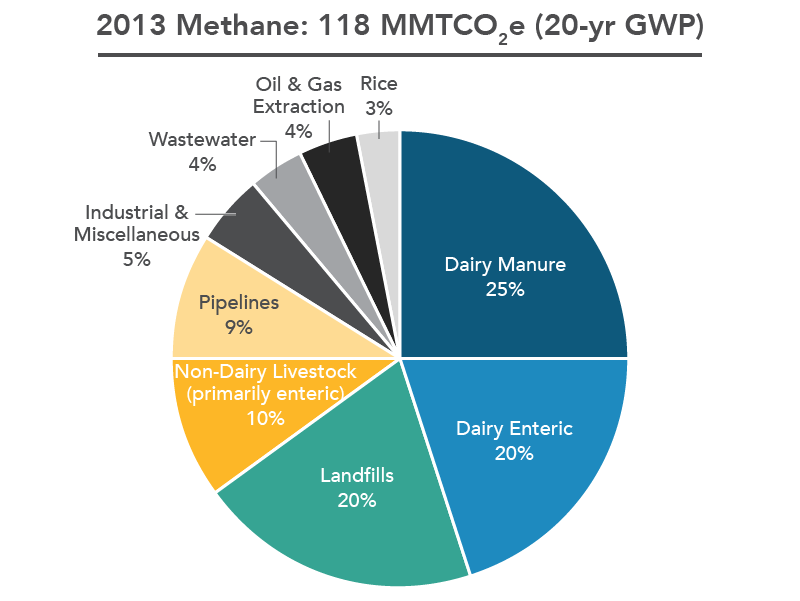
2013 Methane Inventory

Hydrofluorocarbon Inventory

Hydrofluorocarbons (HFC) constitute a class of fluorinated compounds with a wide range of lifetimes and global warming potentials (GWPs). Many HFCs have short lifetimes thus are considered SLCPs. The HFC SLCP inventory includes nine short-lived HFCs from the 2015 Edition of California's official greenhouse gas emission inventory. These are: HFC-125, HFC-134a, HFC-143a, HFC-152a, HFC-227ea, HFC-245fa, HFC-32, HFC-365mfc, and HFC-43-10mee.

Short-Lived HFC Emissions Data and Documentation

Short-Lived HFC Summary 100-yr GWP
Short-Lived HFC Summary 20-yr GWP
HFC Technical Support Document
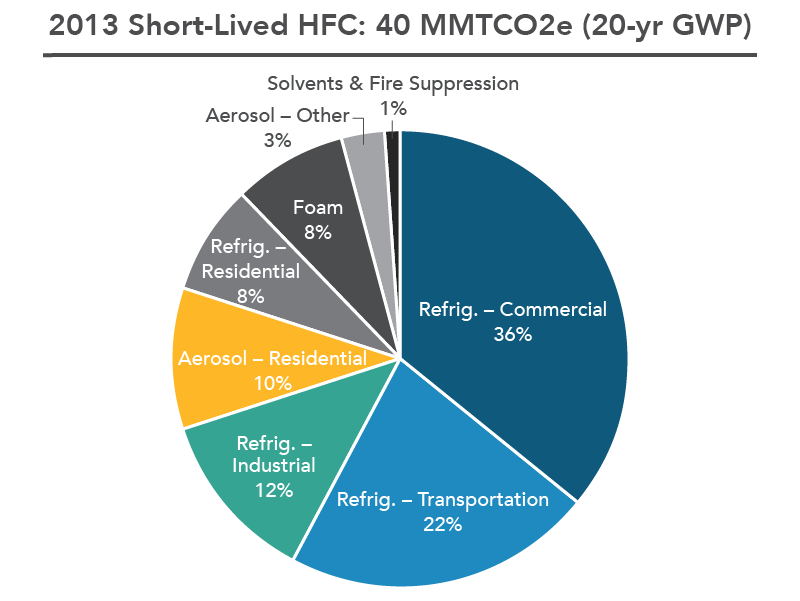
2013 Sort Lived HFC

Black Carbon Inventory

The California Air Resources Board has developed a statewide emission inventory for black carbon in support of the Short-Lived Climate Pollutant Strategy. The black carbon inventory uses elemental carbon (EC) speciation profiles developed by CARB as a proxy for black carbon. Speciation profiles are applied to PM2.5 mass emissions to estimate black carbon emissions.

Black Carbon Emissions Data and Documentation

Black Carbon Summary 100-yr GWP
Black Carbon Summary 20-yr GWP
2015 Edition Black Carbon Technical Support Document

Pie Chart of Non-Forestry Black Carbon Data (included in SLCP black carbon targets)
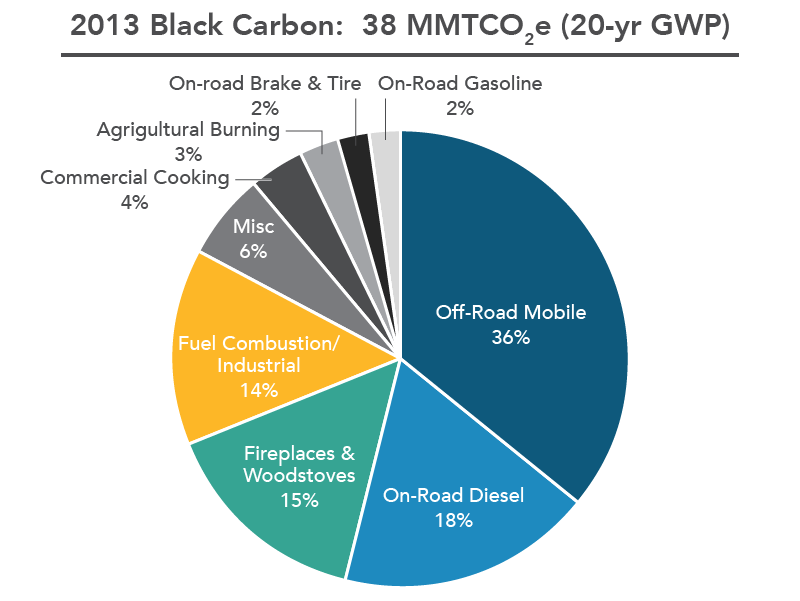
2013 Black Carbon

Forestry Black Carbon Data

The forestry category includes non-agricultural prescribed burning and wildfire emissions. Emissions from these activities exhibit high year-to-year variability and large uncertainty in current and future emissions, and are not included in the SLCP black carbon reduction target. To provide a more representative view of emissions without large year-to-year variability driven by natural forces, forestry emissions are calculated as a ten year average.

Ten Year Average California Forestry Black Carbon Emissions

SourceMMTCO2e (20-yr)MMTCO2e (100-yr)
Prescribed Burning3.61.0
Wildfire86.724.4

Sulfuryl Fluoride

Sulfuryl fluoride (SO2F2) is a fluorinated gas with a lifetime of 36 years. It is used as a pesticide for building fumigation and post-harvest storage of commodities, but is not licensed for use in agricultural fields. Sulfuryl fluoride was believed to have a negligible GWP until 2009, when new research assigned a 100-year GWP of 4090 and a 20-year GWP of 6840. Because sulfuryl fluoride was not identified as a high-GWP gas at the time, it was not included as an AB 32 gas, and is not annually inventoried as a part of CARB's statewide GHG inventory.

The Department of Pesticide Regulation (DPR) tracks usage of sulfuryl fluoride. A summary of 2013 emissions based on DPR data is shown below. Usage for other years can be obtained from DPR.

2013 California Sulfuryl Fluoride Emissions

SourceMMTCO2e (20-yr)MMTCO2e (100-yr)
Structural Fumigation7.64.6
Post-Harvest Storage1.40.8
Other Fumigation0.30.2
Total Emissions*9.45.6

* Totals may not add due to rounding

Short-Lived Climate Pollutants CARB Home Page

SLCP Publications

Proposed Strategy - April 11, 2016
Draft Strategy Report - September 30, 2015
Concept Paper - May 7, 2015

Current Statewide Greenhouse Gas Emission Inventory

Contact
Case Settlement
Off
Legislative Bill Tracking
Off
Division field is automatically filled by OIS on 06/21/2021
Off

GHG 2020 Business-as-Usual Emissions Projection

2014 Edition BAU Emissions Projection

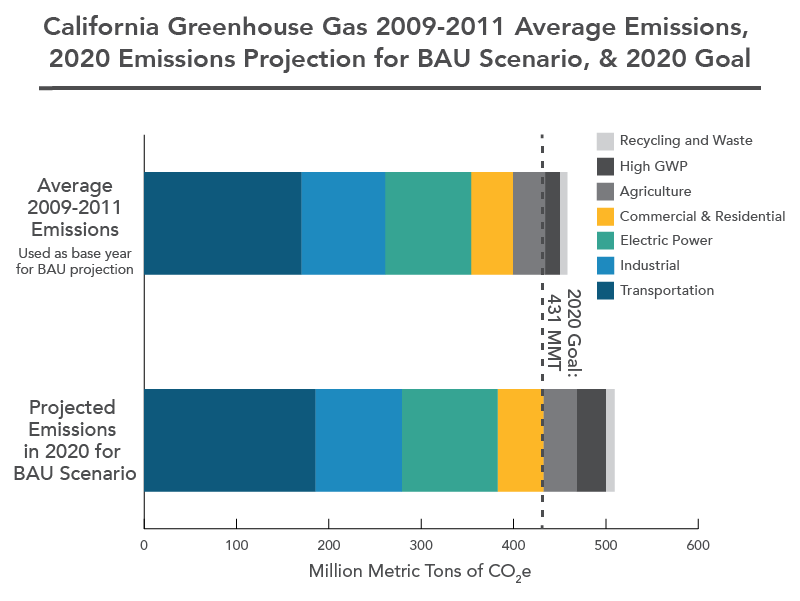
An emission projection estimates future emissions based on current emissions, expected regulatory implementation, and other technological, social, economic, and behavioral patterns. The projected 2020 emissions provided here represent a Business-as-Usual (BAU) scenario assuming none of the Scoping Plan measures are implemented. The 2020 BAU emissions estimate assists the Air Resources Board (ARB) in demonstrating progress toward meeting the 2020 goal of 431 MMTCO2e (the revised target using Global Warming Potentials (GWP) from the IPCC Forth Assessment Report (AR4)).

The 2020 BAU emissions projection has been revisited in support of the First Update to the Scoping Plan (2014). This projection accounts for updates to the economic forecasts of fuel and energy demand as well as other factors. It also accounts for the effects of the recent economic recession and the projected recovery. Data sources, methods and assumptions are available in the links section below. CARB prepared the first version of 2020 GHG emissions projection in 2008 for the original AB32 Scoping Plan and a second version in 2010 to support Cap & Trade. Previous versions of the 2020 projection are archived and provided below.

The 2020 BAU emissions projection uses the average statewide GHG emissions for 2009-2011 as the base year. Using a three year average dampens variations that may make a given year unsuitable as the basis for projection analysis. For example, using a hot and dry year, with higher power consumption and less hydroelectric power generation as the base year would skew the projected emissions associated with power generation. The current 2020 BAU emissions projection uses GWP values from IPCC AR4, while the previous versions used IPCC Second Assessment Report (SAR) GWPs. The total emissions expected in the 2020 BAU scenario includes reductions anticipated from Pavley I and the Renewable Electricity Standard (30 MMTCO2e total). With these reductions in the baseline, estimated 2020 statewide BAU emissions are 509 MMTCO2e.

2020 BAU Emissions

The bar graph below shows the 2020 BAU emissions relative to the base year average of 2009-2011 by sector. Half the BAU growth in 2020 comes from the Transportation and Electric Power sectors, while another third comes from the High GWP sector alone. Energy use (as seen in the transportation and electricity use emissions) is a driving force leading to emissions increases in the future. Fortunately, these emissions are regulated under Cap & Trade so actual 2020 emissions will be lower than the BAU scenario.

Below the chart are links to materials and methods related to the 2020 BAU emissions projection. These include a summary of 2020 BAU emissions by sector, emissions reduction contribution from each complementary measure, documentation of data sources and methods, time series of projected BAU emissions, and links to previous projections created in support of the AB 32 Scoping Plan (2008) and the Cap & Trade Regulation (2010).


GHG BAU Scenario

Additional Resources

2020 BAU Emissions by Scoping Plan Categories

Data Sources, Methods, & Assumptions

Emissions Reductions from Scoping Plan Measures

2020 BAU Projection Time Series 2009-2020

AB 32 Scoping Plan


Archived 2020 Business-as-Usual Emissions Projection

Overview of Archived Projections

The two previous California 2020 Business-as-Usual (BAU) greenhouse gas (GHG) emissions projections used in the AB 32 Scoping Plan (2008) and for the Cap & Trade Regulation (2010) are archived below. These projections were used to assess the GHG reductions necessary to return California to 1990 emission level based on the GHG inventories published by ARB in support of its programs. California's current 2020 GHG emissions projection is available above.

The two previous 2020 BAU emissions projections are archived below.

2020 BAU Projection VersionArchive Document
Original Scoping Plan (2008)

Archive Documentation
Detailed 2020 BAU Emissions Projection and Methodology

Cap-and-Trade Update (2010)

Archive Documentation
Status of Scoping Plan Recommended Measures

Hero Image
Contact
Case Settlement
Off
Legislative Bill Tracking
Off
Division field is automatically filled by OIS on 06/21/2021
Off

GHG 1990–2004 Inventory & Documentation

This page includes information for the original version California's GHG inventory published by CARB in November 2007. The 1990-2004 GHG inventory provided the 1990 emission level which became the 2020 GHG limit pursuant to the California Global Warming Solutions Act (AB 32). Since the first inventory edition, CARB has annually updated the GHG inventory with current year data and improved methodology. The current year inventory page has the most recent inventory data.

The original 1990-2004 inventory was based on the global warming potential (GWP) values in the Intergovernmental Panel on Climate Change (IPCC) Second Assessment Report (SAR). IPCC periodically updates GWP values with improved scientific understanding of the intensity of infrared absorption by each GHG and how long the GHG remain in the atmosphere. For each annual update of the inventory since 2014, CARB has been using the GWP values from the IPCC Fourth Assessment Report (AR4) consistent with current international and national GHG inventory practices. The original 1990-2004 inventory has been converted from SAR to AR4 GWPs (but has not been recalculated based on the updated methodology and data sources employed by more recent inventory editions). This webpage presents the inventory based on AR4 GWPs and continues to make available the original inventory in SAR GWPs for archival purposes.

The GHG emissions and sinks are categorized in two ways:

  1. Process-oriented categories; follows the IPCC categorization to ensure consistency and comparability with international inventories.
  2. Economic sectors; enables comparison with other ARB emission inventories, which are similarly categorized.

1990–2004 Inventory Data

1990-2004 inventory (AR4 GWPs)

1990–2004 Inventory by IPCC Category - Full Detail (AR4) [PDF]
1990–2004 Inventory by IPCC Category - Full Detail (AR4) [Excel]
1990–2004 Inventory by Economic Sector - Full Detail (AR4) [PDF]
1990–2004 Inventory by Economic Sector - Full Detail (AR4) [Excel]
Land Use, Land Use Change, and Forestry - Net CO2 Flux [PDF]

Summary of the 1990–2004 Inventory (AR4 GWPs)

1990–2004 Inventory by IPCC Category - Summary (AR4) [PDF]
1990–2004 Inventory by Economic Sector - Summary (AR4) [Excel]

1990–2004 inventory (SAR GWPs)

1990–2004 Inventory by IPCC Category - Full Detail [PDF]
1990–2004 Inventory by IPCC Category - Full Detail [Excel]
1990–2004 Inventory by Economic Sector - Full Detail [PDF]
1990–2004 Inventory by Economic Sector - Full Detail [Excel]
Land Use, Land Use Change, and Forestry - Net CO2 Flux [PDF]

Summary of the 1990–2004 Inventory (SAR GWPs)

1990–2004 Inventory by IPCC Category - Summary [PDF]
1990–2004 Inventory by Economic Sector - Summary [PDF]
1990–2004 Technical Support Document [PDF]

1990-2004 GHG Inventory Query Tool

Contact
Case Settlement
Off
Legislative Bill Tracking
Off
Division field is automatically filled by OIS on 06/21/2021
Off
GHG 1990 Emissions Level & 2020 Limit

The 2020 GHG emission limit is 431 MMTCO2e using IPCC Fourth Assessment Report GWPs

The Global Warming Solutions Act of 2006 (AB 32) requires that CARB determine the statewide greenhouse gas emissions level in 1990. The act also requires that the Board approve a statewide greenhouse gas emissions limit, equal to the 1990 level, as a limit to be achieved by 2020. This limit is an aggregated statewide limit, and is not sector- or facility-specific. The 2020 GHG emissions limit is 431 million metric tons of carbon dioxide equivalent (MMTCO2e). In 2016, Senate Bill 32, California Global Warming Solutions Act of 2006: Emissions Limit (SB 32) further required California to reduce statewide GHG emissions to 40% below the 1990 level by 2030.

CARB Approval of Updated 2020 Limit

Calculation of the original 1990 limit approved in 2007 was revised in 2014 using the scientifically updated Intergovernmental Panel on Climate Change (IPCC) Fourth Assessment Report (AR4) global warming potential (GWP) values, to 431 MMTCO2e. The Board approved 431 MMTCO2e as the 2020 emission limit with the approval of the First Update to the Scoping Plan on May 22, 2014.

Setting the Original 2020 Limit

During 2007, CARB staff developed a 1990–2004 greenhouse gas emission inventory to determine the 1990 emission level, which the Board approved as the 2020 limit of 427 MMTCO2e. This value was based on IPCC second assessment report GWPs. The Board approved the 2020 limit on December 6, 2007. The Board materials associated with the original 2020 limit are available at the links below. This original value was updated in the 2014 Scoping Plan Update as discussed previously.

Staff Presentation for Board
Board Meeting Archive
Meeting Transcripts
Public Comments Received
Board Resolution

The staff report titled "California 1990 Greenhouse Gas Emissions Level and 2020 Emissions Limit" discusses the original development of the 1990 statewide emissions level and provides a summary of the key emissions sources, the methodologies used to calculate the emissions, and the sources of data. These methods use the original IPCC second assessment report GWPs.

Staff Report: California 1990 Greenhouse Gas Emissions Level and 2020 Emissions Limit
Appendix A-1: Summary 1990 Inventory by IPCC Category
Appendix A-2: 1990 Inventory by IPCC Category
Appendix B: 1990 Carbon Flux Table and Diagram
Appendix C: California Global Warming Solutions Act of 2006

Additional Resources

1990 Inventory Data, Reports & Documentation
1990 Inventory Query Tool

Hero Image
Contact
Case Settlement
Off
Legislative Bill Tracking
Off
Division field is automatically filled by OIS on 06/21/2021
Off
Consumer Products Fee Regulation Workgroup Activity

This page contains documents related to the informal events that pertain to the Consumer Products Fee Regulation Workgroup Activity. Informal regulatory activity refers to all activity that is not directly involved in the formal rulemaking process. By selecting an item below, you can access documents associated with workgroup's regulation activity.


Current Activities


Previous Methodologies and Suggested Process


Subscribe for Consumer Products Updates. If you are subscribed to the consumer products topic, you will receive information updates on the activities of the Consumer Products Fee Regulation Workgroup.

Hero Image
Case Settlement
Off
Legislative Bill Tracking
Off
Division field is automatically filled by OIS on 06/21/2021
Off
Program Guidance

Regulatory Guidance Documents

CARB developed the following regulatory guidance documents to clarify specific sections of the Consumer Products Regulation. Unlike the regulation itself, this guidance does not have the force of law. It is not intended to and cannot establish new mandatory requirements beyond those that are already in the Consumer Products Regulation, and it does not supplant, replace or amend any of the legal requirements of the regulation. Conversely, this guidance’s omission or truncation of regulatory requirements does not relieve responsible parties of their legal obligation to fully comply with all requirements of the regulation.

Documents

Description

Guidance Pertaining to Gear, Chain or Wire Lubricant Product Labeling

Informative guidance document for Gear, Chain or Wire Lubricant product labeling.
Case Settlement
Off
Legislative Bill Tracking
Off
Division field is automatically filled by OIS on 06/21/2021
On