Air Quality Planning and Science Division

Product Determination

The Formal Product Category Determination Process:

Parties who sell, supply, offer for sale, or manufacture for sale consumer products in California are responsible for complying with State and local regulations for consumer products. CARB staff can help guide responsible parties to appropriate sections of the State regulation which pertain to their products or raw material components of their products. Responsible parties may also request formal determinations for specific products by submitting product determination request forms and necessary materials for each product.

Email your complete application and all questions concerning the product determination process to Consumer Products Help.

Documents

Description

Product Determination Application Guidance

Informative guidance document for the process of requesting a product category determination.

Product Determination Application Form and Instructions

Form to be submitted to make a formal product category determination request with instructions attached.
Case Settlement
Off
Legislative Bill Tracking
Off
Division field is automatically filled by OIS on 06/21/2021
Off

GHG Inventory Glossary

A

Activity Data
Data on the magnitude of a human activity resulting in emissions or removals taking place during a given period of time. Data on energy use, metal production, land areas, management systems, lime and fertilizer use and waste arisings are examples of activity data. (IPCC)

Aerosols
A collection of airborne solid or liquid particles, with a typical size between 0.01 and 10 micrometer that reside in the atmosphere for at least several hours. Aerosols may be of either natural or anthropogenic origin. Aerosols may influence climate in several ways: directly through scattering and absorbing radiation, and indirectly by acting as cloud condensation nuclei or modifying the optical properties and lifetime of clouds. (IPCC)

Afforestation
Planting of new forests on lands that historically have not contained forests. (IPCC)

Air Pollutant
See the CARB Glossary.

Anthropogenic
The term "anthropogenic", in the context of greenhouse gas inventories, refers to greenhouse gas emissions and removals that are a direct result of human activities or are the result of natural processes that have been affected by human activities. (USEPA)

Atmosphere
The gaseous envelope surrounding the Earth. The dry atmosphere consists almost entirely of nitrogen (78.1% volume mixing ratio) and oxygen (20.9% volume mixing ratio), together with a number of trace gases, such as argon (0.93% volume mixing ratio), helium and radiatively active greenhouse gases such as carbon dioxide (0.035% volume mixing ratio) and ozone. In addition, the atmosphere contains the greenhouse gas water vapor, whose amounts are highly variable but typically around 1% volume mixing ratio. The atmosphere also contains clouds and aerosols. (IPCC)


B

Biogenic Source
See the CARB Glossary.

Biogeochemical Cycle
Movement of chemical elements from organism to physical environment to organism in more or less circular pathways. (NASA)

Biomass
Either (1) the total mass of living organisms in a given area or of a given species usually expressed as dry weight; or (2) Organic matter consisting of or recently derived from living organisms (especially regarded as fuel) excluding peat. Includes products, by-products and waste derived from such material. (IPCC)

Biomass Waste
Organic non-fossil material of biological origin that is a byproduct or a discarded product. "Biomass waste" includes municipal solid waste from biogenic sources, landfill gas, sludge waste, agricultural crop byproducts, straw, and other biomass solids, liquids, and gases; but excludes wood and wood-derived fuels (including black liquor), biofuels feedstock, biodiesel, and fuel ethanol. Note: EIA "biomass waste" data also include energy crops grown specifically for energy production, which would not normally constitute waste. (EIA)

Black Carbon
Operationally defined aerosol species based on measurement of light absorption and chemical reactivity and/or thermal stability; consists of soot, charcoal and/or possible light absorbing refractory organic matter (Charlson and Heintzenberg, 1995, p. 401). (IPCC)


C

Carbon Cycle
All parts (reservoirs) and fluxes of carbon. The cycle is usually thought of as four main reservoirs of carbon interconnected by pathways of exchange. The reservoirs are the atmosphere, terrestrial biosphere (usually includes freshwater systems), oceans, and sediments (includes fossil fuels). The annual movements of carbon, the carbon exchanges between reservoirs, occur because of various chemical, physical, geological, and biological processes. The ocean contains the largest pool of carbon near the surface of the Earth, but most of that pool is not involved with rapid exchange with the atmosphere. (NASA)

Carbon Dioxide (CO2)
A naturally occurring gas, and also a by-product of burning fossil fuels and biomass, as well as land-use changes and other industrial processes. It is the principal anthropogenic greenhouse gas that affects the Earth's radiative balance. It is the reference gas against which other greenhouse gases are measured and therefore has a Global Warming Potential of 1. (IPCC)

Carbon Dioxide Equivalent (CO2e)
See the CARB Glossary.

Carbon Intensity
The amount of carbon by weight emitted per unit of energy consumed. A common measure of carbon intensity is weight of carbon per British thermal unit (Btu) of energy. When there is only one fossil fuel under consideration, the carbon intensity and the emissions coefficient are identical. When there are several fuels, carbon intensity is based on their combined emissions coefficients weighted by their energy consumption levels. (EIA)

Carbon Sequestration
The fixation of atmospheric carbon dioxide in a carbon sink through biological or physical processes. (EIA)

Chlorofluorocarbons (CFCs)
Greenhouse gases covered under the 1987 Montreal Protocol and used for refrigeration, air conditioning, packaging, insulation, solvents, or aerosol propellants. Because they are not destroyed in the lower atmosphere, CFCs drift into the upper atmosphere where, given suitable conditions, they break down ozone. These gases are being replaced by other compounds, including hydrochlorofluorocarbons and hydrofluorocarbons, which are greenhouse gases covered under the Kyoto Protocol. (IPCC)

Climate
Climate in a narrow sense is usually defined as the "average weather" or more rigorously as the statistical description in terms of the mean and variability of relevant quantities over a period of time ranging from months to thousands or millions of years. The classical period is 30 years, as defined by the World Meteorological Organization (WMO). These relevant quantities are most often surface variables such as temperature, precipitation, and wind. Climate in a wider sense is the state, including a statistical description, of the climate system. (IPCC)

Climate Change
Climate change refers to a statistically significant variation in either the mean state of the climate or in its variability, persisting for an extended period (typically decades or longer). Climate change may be due to natural internal processes or external forcings, or to persistent anthropogenic changes in the composition of the atmosphere or in land use. (IPCC)

Cogeneration
The use of waste heat from thermal electricity-generation plants. The heat is e.g. condensing heat from steam turbines or hot flue gases exhausted from gas turbines, for industrial use, buildings, or district heating. Synonym for "Combined Heat and Power (CHP)" generation. (IPCC)

Combined Heat and Power (CHP)
Combined heat and power is the simultaneous production of both electricity and useful heat for application by the producer or to be sold to other users with the aim of better utilisation of the energy used. Public utilities may utilise part of the heat produced in power plants and sell it for public heating purposes. Industries as auto-producers may sell part of the excess electricity produced to other industries or to electric utilities. (IPCC)

Consistency
Consistency means that an inventory should be internally consistent in all its elements over a period of years. An inventory is consistent if the same methodologies are used for the base and all subsequent years and if consistent data sets are used to estimate emissions or removals from sources or sinks. (IPCC)

Continuous Emission Monitor (CEM)
See the CARB Glossary.

Criteria Air Pollutant
See the CARB Glossary.


D

Deforestation
Those practices or processes that result in the change of forested lands to non-forest uses. This is often cited as one of the major causes of the enhanced greenhouse effect for two reasons: 1) the burning or decomposition of the wood releases carbon dioxide; and 2) trees that once removed carbon dioxide from the atmosphere in the process of photosynthesis are no longer present and contributing to carbon storage. (UNFCC)

Distillate Fuel Oil
A general classification for one of the petroleum fractions produced in conventional distillation operations. It includes diesel fuels and fuel oils. Products known as No. 1, No. 2, and No. 4 diesel fuel are used in on-highway diesel engines, such as those in trucks and automobiles, as well as off-highway engines, such as those in railroad locomotives and agricultural machinery. Products known as No. 1, No. 2, and No. 4 fuel oils are used primarily for space heating and electric power generation. (EIA)


E

Emissions
Releases of gases to the atmosphere (e.g. the release of carbon dioxide during fuel combustion). Emissions can be either intended or unintended releases. (UNFCC)

Emission Factor
A coefficient that quantifies the emissions or removals of a gas per unit activity. Emission factors are often based on a sample of measurement data, averaged to develop a representative rate of emission for a given activity level under a given set of operating conditions. (IPCC)

Emission Inventory
See the CARB Glossary.


F

Fluorocarbons
Carbon-fluorine compounds that often contain other elements such as hydrogen, chlorine, or bromine. Common fluorocarbons include chlorofluorocarbons (CFCs), hydrochlorofluorocarbons (HCFCs), hydrofluorocarbons (HFCs), and perfluorocarbons (PFCs). (UNFCC)

Flux
Either (1) Raw materials, such as limestone, dolomite, lime, and silica sand, which are used to reduce the heat or other energy requirements of thermal processing of minerals (such as the smelting of metals). Fluxes also may serve a dual function as a slagging agent. (2) The rate of flow of any liquid or gas, across a given area; the amount of this crossing a given area in a given time. (e.g., "Flux of CO2 absorbed by forests"). (IPCC)

Fossil Fuel
See the CARB Glossary.

Fuel Combustion
Fuel combustion is the intentional oxidation of materials within an apparatus that is designed to provide heat or mechanical work to a process, or for use away from the apparatus. (IPCC)

Fugitive Emissions
The intentional or unintentional release of greenhouse gases that occur during the exploration, processing, and delivery of fossil fuels to the point of final use. This excludes greenhouse gas emissions from fuel combustion for the production of useful hear or power. It encompasses venting, flaring, and leaks. (IPCC)


G

Geologic Sequestration
A type of engineered sequestration, where captured carbon dioxide is injected for permanent storage into underground geologic reservoirs, such as oil and natural gas fields, saline aquifers, or abandoned coal mines. (EIA)

Global Warming
See the CARB Glossary.

Global Warming Potential (GWP)
See the CARB Glossary.

Global Warming Solutions Act of 2006 (AB 32)
AB 32 requires CARB to develop regulations and market mechanisms that will ultimately reduce California's greenhouse gas emissions by 25 percent by 2020. Specifically, AB 32, requires CARB to: establish a statewide greenhouse gas emissions cap for 2020, based on 1990 emissions by January 1, 2008; adopt mandatory reporting rules for significant sources of greenhouse gases by January 1, 2009; adopt a scoping plan by January 1, 2009 indicating how emission reductions will be achieved from significant greenhouse gas sources via regulations, market mechanisms and other actions; adopt regulations by January 1, 2011 to achieve the maximum technologically feasible and cost-effective reductions in greenhouse gas; and convene an Environmental Justice Advisory Committee, and an Economic and Technology Advancement Advisory Committee to advise CARB. (CARB)

Greenhouse Effect
Trapping and build-up of heat in the atmosphere (troposphere) near the earth's surface. Some of the heat flowing back toward space from the earth's surface is absorbed by water vapor, carbon dioxide, ozone, and several other gases in the atmosphere and then reradiated back toward the earth's surface. If the atmospheric concentrations of these greenhouse gases rise, the average temperature of the lower atmosphere will gradually increase. (UNFCC)

Greenhouse Gas
Any gas that absorbs infrared radiation in the atmosphere. Greenhouse gases include, but are not limited to, water vapor, carbon dioxide (CO2), methane (CH4), nitrous oxide (N2O), hydrochlorofluorocarbons (HCFCs), ozone (O3), hydrofluorocarbons (HFCs), perfluorocarbons (PFCs), and sulfur hexafluoride (SF6). (UNFCC)

Gross Domestic Product (GDP)
The sum of gross value added, at purchasers' prices, by all resident and non-resident producers in the economy, plus any taxes and minus any subsidies not included in the value of the products in a country or a geographic region for a given period, normally one year. It is calculated without deducting for depreciation of fabricated assets or depletion and degradation of natural resources. (IPCC)


H

Halocarbons
A collective term for the group of partially halogenated organic species, including the chlorofluorocarbons (CFCs), hydrochlorofluorocarbons (HCFCs), hydrofluorocarbons (HFCs), halons, methyl chloride, methyl bromide, etc. Many of the halocarbons have large Global Warming Potentials. The chlorine and bromine-containing halocarbons are also involved in the depletion of the ozone layer. (IPCC)

Hydrocarbons
Strictly defined as molecules containing only hydrogen and carbon. The term is often used more broadly to include any molecules in petroleum which also contains molecules with S, N, or O An unsaturated hydrocarbon is any hydrocarbon containing olefinic or aromatic structures. (IPCC)

Hydrofluorocarbons (HFCs)
Halocarbons containing only hydrogen, fluorine and carbon atoms. Because HFCs contain no chlorine, bromine, or iodine, they do not deplete the ozone layer. Like other halocarbons, they are potent greenhouse gases. (IPCC)


I

Intergovernmental Panel on Climate Change
The IPCC was established jointly by the United Nations Environment Programme and the World Meteorological Organization in 1988. The purpose of the IPCC is to assess information in the scientific and technical literature related to all significant components of the issue of climate change. The IPCC draws upon hundreds of the world's expert scientists as authors and thousands as expert reviewers. Leading experts on climate change and environmental, social, and economic sciences from some 60 nations have helped the IPCC to prepare periodic assessments of the scientific underpinnings for understanding global climate change and its consequences. With its capacity for reporting on climate change, its consequences, and the viability of adaptation and mitigation measures, the IPCC is also looked to as the official advisory body to the world's governments on the state of the science of the climate change issue. For example, the IPCC organized the development of internationally accepted methods for conducting national greenhouse gas emission inventories. (IPCC)


K

Kyoto Protocol
The Kyoto Protocol to the United Nations Framework Convention on Climate Change (UNFCCC) was adopted in 1997 in Kyoto, Japan, at the Third Session of the Conference of the Parties (COP) to the UNFCCC. It contains legally binding commitments, in addition to those included in the UNFCCC. Countries included in Annex B of the Protocol (most Organisation for Economic Cooperation and Development countries and countries with economies in transition) agreed to reduce their anthropogenic greenhouse gas emissions (carbon dioxide, methane, nitrous oxide, hydrofluorocarbons, perfluorocarbons, and sulphur hexafluoride) by at least 5% below 1990 levels in the commitment period 2008 to 2012. The Kyoto Protocol entered into force on 16 February 2005. (IPCC)


L

Land Use and Land Use Change
Land use refers to the total of arrangements, activities and inputs undertaken in a certain land cover type (a set of human actions). The term land use is also used in the sense of the social and economic purposes for which land is managed (e.g., grazing, timber extraction and conservation). Land use change refers to a change in the use or management of land by humans, which may lead to a change in land cover. Land cover and land use change may have an impact on the surface albedo, evapotranspiration, sources and sinks of greenhouse gases, or other properties of the climate system and may thus have a radiative forcing and/or other impacts on climate, locally or globally. (IPCC)


M

Methane (CH4)
A hydrocarbon that is a greenhouse gas with a global warming potential most recently estimated at 21. Methane is produced through anaerobic (without oxygen) decomposition of waste in landfills, animal digestion, decomposition of animal wastes, production and distribution of natural gas and petroleum, coal production, and incomplete fossil fuel combustion. (UNFCC)

Metric Ton
Common international measurement for the quantity of greenhouse gas emissions. A metric ton is equal to a Megagram, (Mg), 1000 kilograms, 2204.6 pounds, or 1.1023 short tons. (UNFCC)

Mobile Sources
Pollution sources that move. These sources include vehicles, engines, and motorized equipment that produce exhaust and evaporative emissions. (USEPA)

Model
A model is a quantitatively-based abstraction of a real-world situation which may simplify or neglect certain features to better focus on its more important elements. (IPCC)

Municipal Solid Waste (MSW)
Residential solid waste and some non-hazardous commercial, institutional, and industrial wastes. This material is generally sent to municipal landfills for disposal. (UNFCC)


N

Natural Sources
See the CARB Glossary.

Nitrogen Fixation
Conversion of atmospheric nitrogen gas into forms useful to plants and other organisms by lightning, bacteria, and blue-green algae; it is part of the nitrogen cycle. (UNFCC)

Nitrogen Oxides (NOx)
Gases consisting of one molecule of nitrogen and varying numbers of oxygen molecules. Nitrogen oxides are produced in the emissions of vehicle exhausts and from power stations. In the atmosphere, nitrogen oxides can contribute to formation of photochemical ozone (smog), can impair visibility, and have health consequences; they are thus considered pollutants. (UNFCC)

Nitrous Oxide (N2O)
A powerful greenhouse gas with a global warming potential of 298 times that of carbon dioxide (CO2). Major sources of nitrous oxide include soil cultivation practices, especially the use of commercial and organic fertilizers, manure management, fossil fuel combustion, nitric acid production, and biomass burning. (UNFCC)


O

Ozone (O3)
Ozone, the triatomic form of oxygen (O3), is a gaseous atmospheric constituent. In the troposphere, it is created both naturally and by photochemical reactions involving gases resulting from human activities (smog). Tropospheric ozone acts as a greenhouse gas. In the stratosphere, it is created by the interaction between solar ultraviolet radiation and molecular oxygen (O2). Stratospheric ozone plays a dominant role in the stratospheric radiative balance. Its concentration is highest in the ozone layer. (IPCC)

Ozone Depleting Substances (ODS)
A compound that contributes to stratospheric ozone depletion. Ozone-depleting substances (ODS) include CFCs, HCFCs, halons, methyl bromide, carbon tetrachloride, and methyl chloroform. ODS are generally very stable in the troposphere and only degrade under intense ultraviolet light in the stratosphere. When they break down, they release chlorine or bromine atoms, which then deplete ozone. (IPCC)


P

Perfluorocarbons (PFCs)
Synthetically produced halocarbons containing only carbon and fluorine atoms. They are characterized by extreme stability, non-flammability, low toxicity, zero ozone depleting potential, high global warming potential. (IPCC)

Photosynthesis
The process by which plants take carbon dioxide from the air (or bicarbonate in water) to build carbohydrates, releasing oxygen in the process. There are several pathways of photosynthesis with different responses to atmospheric carbon dioxide concentrations. (IPCC)

Point Sources
A single identifiable source that discharges pollutants into the environment. Examples are smokestack, sewer, ditch, or pipe. (UNFCC)

Process Emissions
Emissions from industrial processes involving chemical transformations other than combustion. (IPCC)


R

Radiative Forcing
A change in the balance between incoming solar radiation and outgoing infrared (i.e., thermal) radiation. Without any radiative forcing, solar radiation coming to the Earth would continue to be approximately equal to the infrared radiation emitted from the Earth. The addition of greenhouse gases to the atmosphere traps an increased fraction of the infrared radiation, reradiating it back toward the surface of the Earth and thereby creates a warming influence. (UNFCC)

Reforestation
Planting of forests on lands that have previously contained forests but that have been converted to some other use. (IPCC)

Residence Time
Average time spent in a reservoir by an individual atom or molecule. Also, this term is used to define the age of a molecule when it leaves the reservoir. With respect to greenhouse gases, residence time usually refers to how long a particular molecule remains in the atmosphere. (UNFCC)

Reservoir
A component of the climate system, other than the atmosphere, which has the capacity to store, accumulate or release a substace of concern, for example, carbon, a greenhouse gas, or a precursor. Oceans, soils, and forests are examples of reservoirs of carbon. Pool is an equivalent term (note that the definition of pool often includes the atmosphere). The absolute quantity of the substance of concern held within a reservoir at a specified time is called the stock. (IPCC)

Respiration
The process whereby living organisms convert organic matter to carbon dioxide, releasing energy and consuming molecular oxygen. (IPCC)


S

Short Ton
Common measurement for a ton in the United States. A short ton is equal to 2,000 lbs or 0.907 metric tons. (UNFCC)

Sink
Any process, activity or mechanism that removes a greenhouse gas, an aerosol or a precursor of a greenhouse gas or aerosol from the atmosphere. (IPCC)

Solar Radiation
Electromagnetic radiation emitted by the Sun. It is also referred to as shortwave radiation. Solar radiation has a distinctive range of wavelengths (spectrum) determined by the temperature of the Sun, peaking in visible wavelengths. (IPCC)

Source
Any process, activity or mechanism that releases a greenhouse gas, an aerosol or a precursor of a greenhouse gas or aerosol into the atmosphere. (IPCC)

Stationary Sources
Non-mobile sources such as power plants, refineries, and manufacturing facilities which emit air pollutants. (CARB)

Sulfur Dioxide (SO2)
A compound composed of one sulfur and two oxygen molecules. Sulfur dioxide emitted into the atmosphere through natural and anthropogenic processes is changed in a complex series of chemical reactions in the atmosphere to sulfate aerosols. These aerosols are believed to result in negative radiative forcing (i.e., tending to cool the Earth's surface) and do result in acid deposition (e.g., acid rain). (UNFCC)

Sulfur Hexafluoride (SF6)
A man-made chemical composted of sulfur and fluorine with a global warming potential of22,800. It is a colorless gas soluble in alcohol and ether, slightly soluble in water. Sulfur hexafluoride is a very powerful greenhouse gas used primarily in electrical transmission and distribution systems and as a dielectric in electronics. (USEPA)


T

Terrestrial Carbon Sequestration
It is the process through which carbon dioxide (CO2) from the atmosphere is absorbed by trees, plants and crops through photosynthesis, and stored as carbon in biomass (tree trunks, branches, foliage and roots) and soils. The term "sinks" is also used to refer to forests, croplands, and grazing lands, and their ability to sequester carbon. Agriculture and forestry activities can also release CO2 to the atmosphere. Therefore, a carbon sink occurs when carbon sequestration is greater than carbon releases over some time period. (USEPA)

Total Organic Gases (TOG)
See the CARB Glossary.

Transparency
Transparency means that the assumptions and methodologies used for an inventory should be clearly explained to facilitate replication and assessment of the inventory by users of the reported information. The transparency of inventories is fundamental to the success of the process for the communication and consideration of information. (UNFCC)

Trend
Designates a change, generally monotonic in time, in the value of a variable. (IPCC)


W

Water Vapor
The most abundant greenhouse gas; it is the water present in the atmosphere in gaseous form. Water vapor is an important part of the natural greenhouse effect. While humans are not significantly increasing its concentration, it contributes to the enhanced greenhouse effect because the warming influence of greenhouse gases leads to a positive water vapor feedback. In addition to its role as a natural greenhouse gas, water vapor plays an important role in regulating the temperature of the planet because clouds form when excess water vapor in the atmosphere condenses to form ice and water droplets and precipitation. (UNFCC)

Weather
Atmospheric condition at any given time or place. It is measured in terms of such things as wind, temperature, humidity, atmospheric pressure, cloudiness, and precipitation. In most places, weather can change from hour-to-hour, day-to-day, and season-to-season. Climate in a narrow sense is usually defined as the "average weather", or more rigorously, as the statistical description in terms of the mean and variability of relevant quantities over a period of time ranging from months to thousands or millions of years. The classical period is 30 years, as defined by the World Meteorological Organization (WMO). These quantities are most often surface variables such as temperature, precipitation, and wind. Climate in a wider sense is the state, including a statistical description, of the climate system. A simple way of remembering the difference is that climate is what you expect (e.g. cold winters) and 'weather' is what you get (e.g. a blizzard). (USEPA)


Contact
Case Settlement
Off
Legislative Bill Tracking
Off
Division field is automatically filled by OIS on 06/21/2021
Off
GHGs Descriptions & Sources in California

Greenhouse Gases

Health and Safety Code 38505 identifies seven greenhouse gases that CARB is responsible to monitor and regulate in order to reduce emissions: carbon dioxide (CO2), methane (CH4), nitrous oxide (N2O), sulfur hexafluoride (SF6), hydrofluorocarbons (HFCs), perfluorocarbons (PFCs), and nitrogen trifluoride (NF3). The fluorinated gases are also referred to as "high global warming potential gases" in the 2008 Scoping Plan.

A list of all GHGs included in the inventory along with GWPs and lifetimes can be found at GWP.

Carbon Dioxide (CO2)

CO2 is an important compound for plant and animal life, as part of the carbon cycle, and as a greenhouse gas (GHG). CO2 is the primary GHG emitted in California.

Sources of CO2 in California

Transportation is the single largest source of CO2 in California; which is primarily comprised of on-road travel. Electricity production, industrial and residential sources also make important contributions to CO2 emissions in California.

Methane (CH4)

CH4 has a global warming potential of 25, indicating one gram of CH4 is equivalent to 25 grams of CO2 over a 100-year timeframe. CH4 is the second highest emitting GHG in California.

Sources of CH4 in California

Agriculture accounts for the majority of emissions, primarily from livestock enteric fermentation and manure management. Industrial sources and landfills are also important sources of CH4. Other sources contribute only a small fraction to CH4 emissions, and include residential, transportation, electricity generation, and commercial sources.

Nitrous Oxide (N2O)

N2O has a global warming potential of 298, indicating emission of one gram of N2O is equivalent to 298 grams of CO2

Sources of N2O in California

Agriculture accounts for the majority of N2O emissions, primarily from fertilizer and manure added to soil. Commercial and residential use of nitrogen fertilizer on turf and transportation are also important sources of N2O. Industrial sources of N2O include solid waste and wastewater treatment, manufacturing, refining and other sources.

High Global Warming Potential Gases (High-GWP)

High global warming potential (High-GWP) greenhouse gases are fluorine-containing gases including sulfur hexafluoride (SF6), nitrogen trifluoride (NF3), perfluorocarbons (PFCs), and hydrofluorocarbons (HFCs). High-GWP gases account for 5.6% of California's 2021 GHG emissions. It is important to track these compounds due to their long lifetimes, and high global warming potentials.

Sources of High-GWP Gases

PFCs and HFCs are used as substitutes for chlorofluorocarbons (CFCs) which destroy stratospheric ozone. SF6 is used in electricity transmission and distribution and in semiconductor manufacturing. Semiconductor manufacturing also emits a small amount of NF3 which was added to the inventory as required by California Senate Bill 104 passed in 2009, because it is a potent GHG.

Contact
Case Settlement
Off
Legislative Bill Tracking
Off
Division field is automatically filled by OIS on 06/21/2021
Off
GHG Global Warming Potentials

Each greenhouse gas (GHG) has a global warming potential value, which reflects the climate forcing of a kilogram of emissions relative to the same mass of carbon dioxide (CO2). This number is calculated by the Intergovernmental Panel on Climate Change (IPCC), based on the intensity of infrared absorption by each GHG and how long emissions remain in the atmosphere. GWPs are calculated using a set time horizon. All GWPs used for GHG inventory purposes are considered over a 100-yr timeframe. GWPs are updated periodically with improvements to the underlying science.

100-yr GWPs from the IPCC second assessment report (SAR) and fourth assessment report (AR4)

AR4 GWPs are used for the current emission inventory

Gas NameFormulaLifetime (years)SAR GWPAR4 GWPPercent Change
Carbon DioxideCO2 11 
MethaneCH4122125+19%
Nitrous OxideN2O114310298-3.9%
Sulphur HexafluorideSF6320023,90022,800-4.6%
Nitrogen TrifluorideNF3740n/a17,200 
Hexafluoroethane (PFC-116)C2F610,0009,20012,200+33%
Octafluoropropane (PFC-218)C3F82,6007,0008,830+26%
Octafluorocyclobutane (PFC-318)C4F83,2008,70010,300+18%
Tetrafluoromethane (PFC-14)CF450,0006,5007,390+14%
Hydrofluorocarbon 125HFC-125292,8003,500+25%
Hydrofluorocarbon 134aHFC-134a141,3001,430+10%
Hydrofluorocarbon 143aHFC-143a523,8004,470+18%
Hydrofluorocarbon 152aHFC-152a1140124-11%
Hydrofluorocarbon 227eaHFC-227ea342,9003,220+11%
Hydrofluorocarbon 23HFC-2327011,70014,800+26%
Hydrofluorocarbon 236faHFC-236fa2406,3009,810+56%
Hydrofluorocarbon 245faHFC-245fa8n/a1,030 
Hydrofluorocarbon 32HFC-325650675+3.8%
Hydrofluorocarbon 365mfcHFC-365mfc9n/a794 
Hydrofluorocarbon 43-10meeHFC-43-10mee161,3001,640+26%

AR4 GWPs for the Inventory

CARB uses 2007 IPCC AR4 GWPs for the current emissions inventory. Some previous versions of the inventory used GWPs from the SAR; the GWP version is documented in all archive datasets. A summary of the SAR versus AR4 GWPs are included in the table above.

Implications of Updated GWPs

GWPs are used to convert GHG emission values to "carbon dioxide equivalent" (CO2e) units. The percent change in GWP (above) will be mirrored in all CO2e emissions.

Contact
Case Settlement
Off
Legislative Bill Tracking
Off
Division field is automatically filled by OIS on 06/21/2021
Off
GHG Emission Inventory Graphs

The California greenhouse gas (GHG) Inventory compiles statewide anthropogenic GHG emissions. The graphs below provide a summary of emissions data for 2023 or for the time series of 2000-2023. All GHG inventory data is available on the current inventory page.

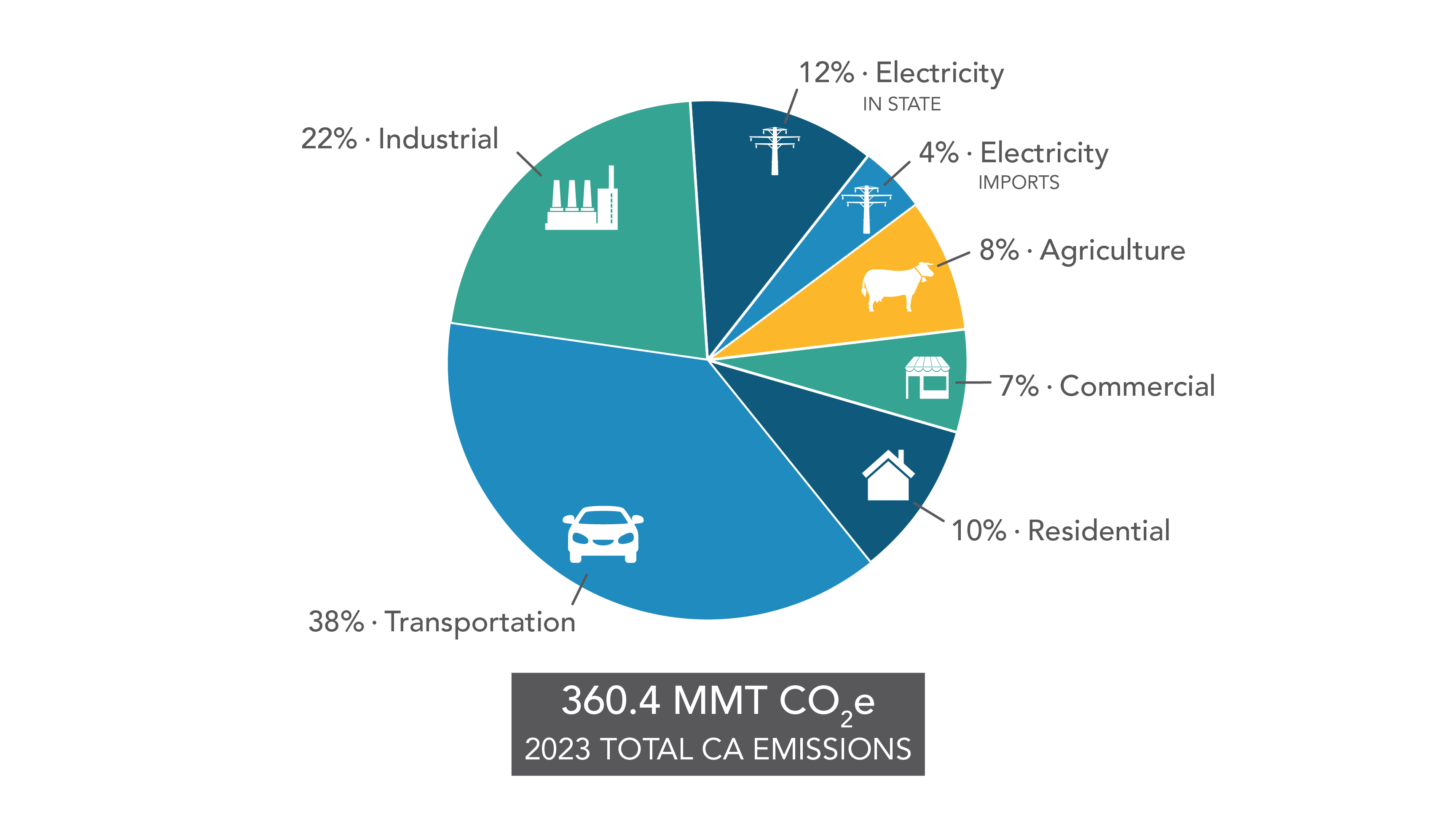
2023 GHG Emissions by Main Economic Sector

A pie chart showing 2023 GHG Emissions by Economic Sector. The chart shows the relative size of 2023 emissions by sector using the Economic Sector/Activity Categorization scheme. Transportation is the largest sector, followed by industrial, electricity generation, agriculture, residential, and commercial. Electricity generation is divided between in-state and imports, with most emissions coming from in-state. For more information on data displayed, contact ghginventory@arb.ca.gov.

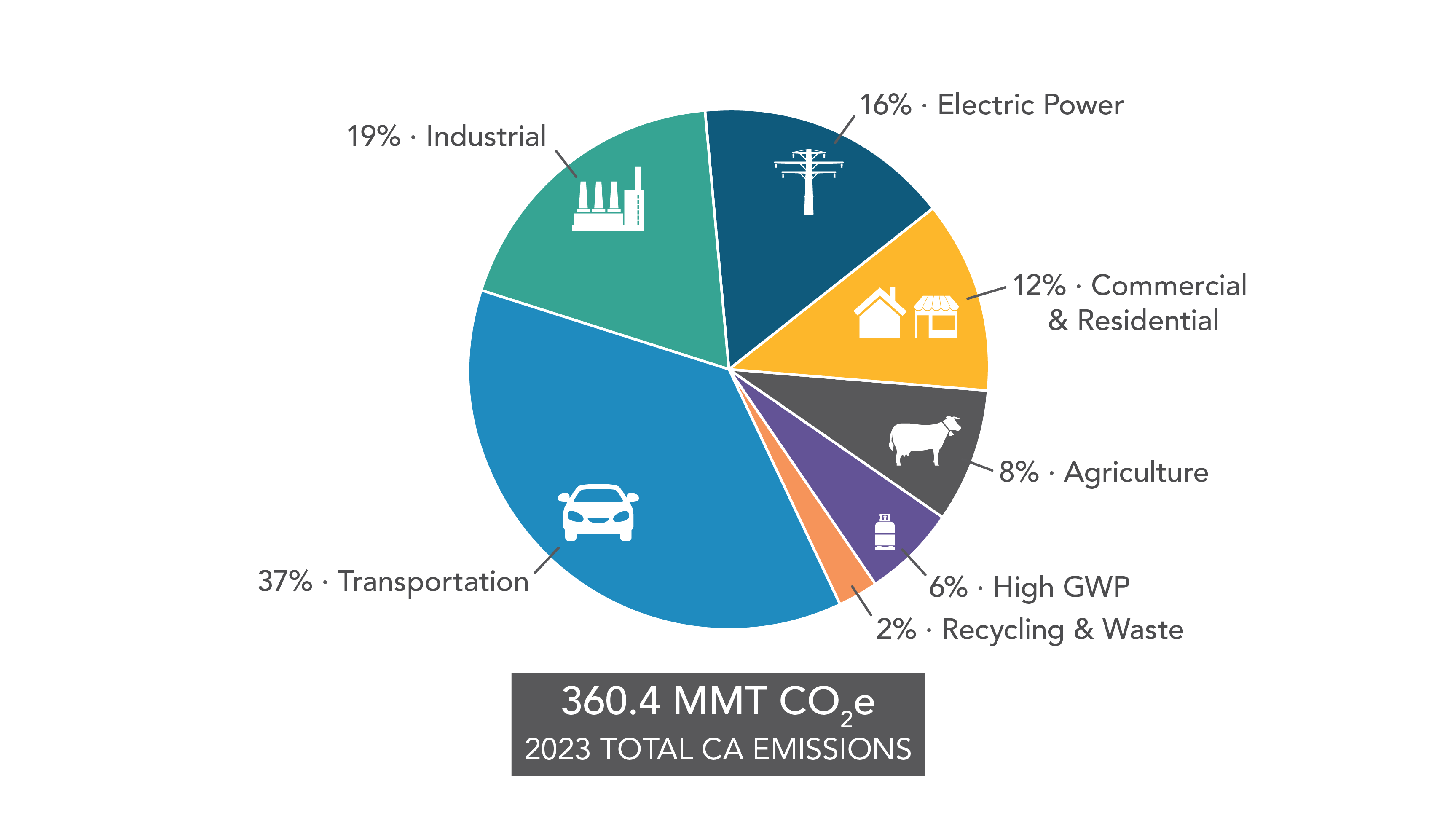
2023 GHG Emissions by Scoping Plan Category

A pie chart showing 2023 GHG Emissions by Scoping Plan sector. The chart shows the relative size of 2023 emissions, organized by the categories in the AB 32 Scoping Plan. Transportation is the largest sector, followed by industrial, electric power, commercial and residential (combined), agriculture, high GWP, and recycling and waste (combined). For more information on data displayed, contact ghginventory@arb.ca.gov.

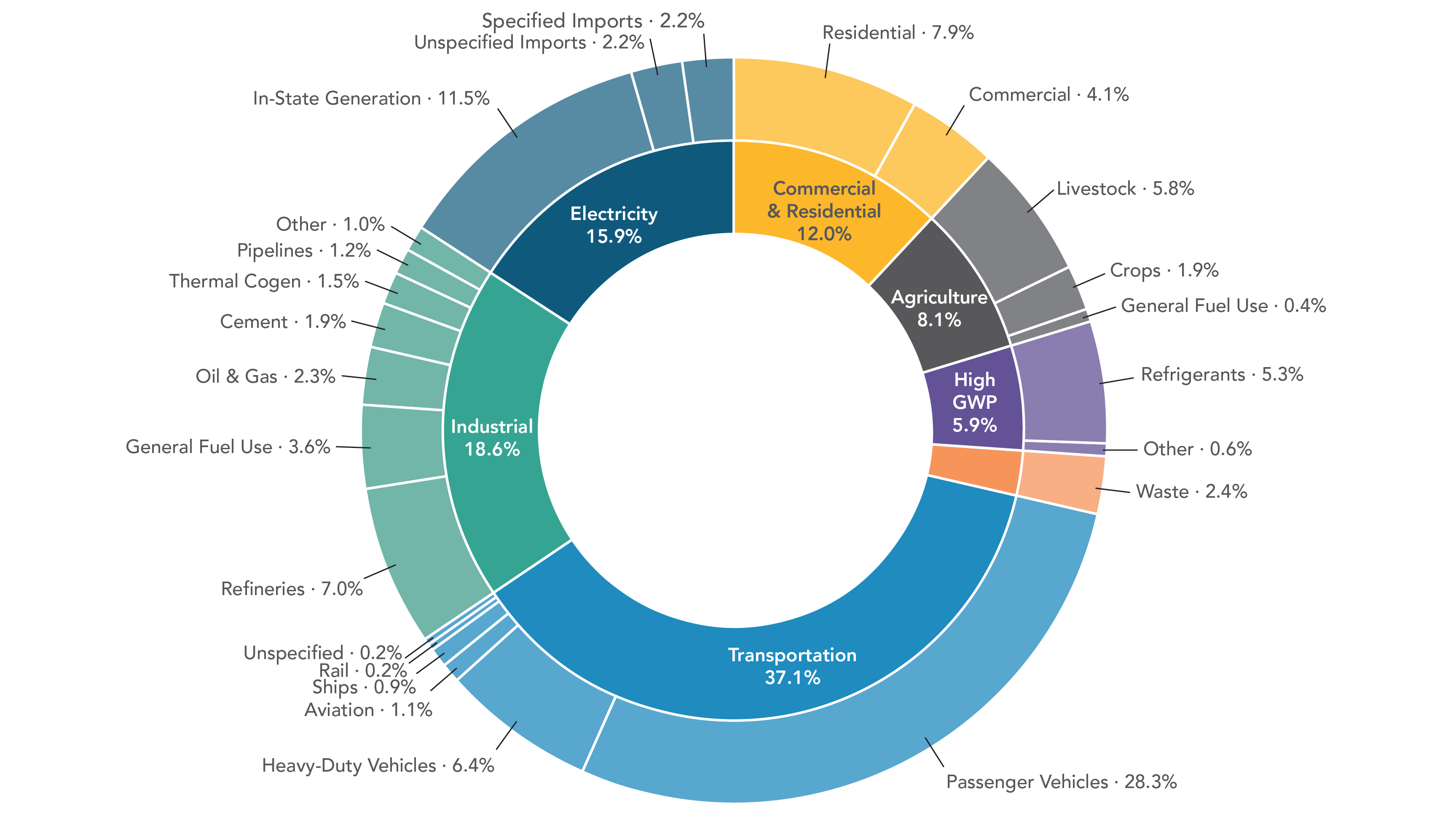
2023 GHG Emission by Scoping Plan Sub-Category

A multi-level pie chart showing 2023 GHG emissions by Scoping Plan sector and sub-sector. The inner ring shows the Scoping Plan sectors, while the outer shows the sub-sectors. In descending order, from largest to smallest source of emissions, the sectors are: Transportation, Industrial, Electricity, Commercial and Residential (combined), Agriculture, High GWP, and finally Waste.

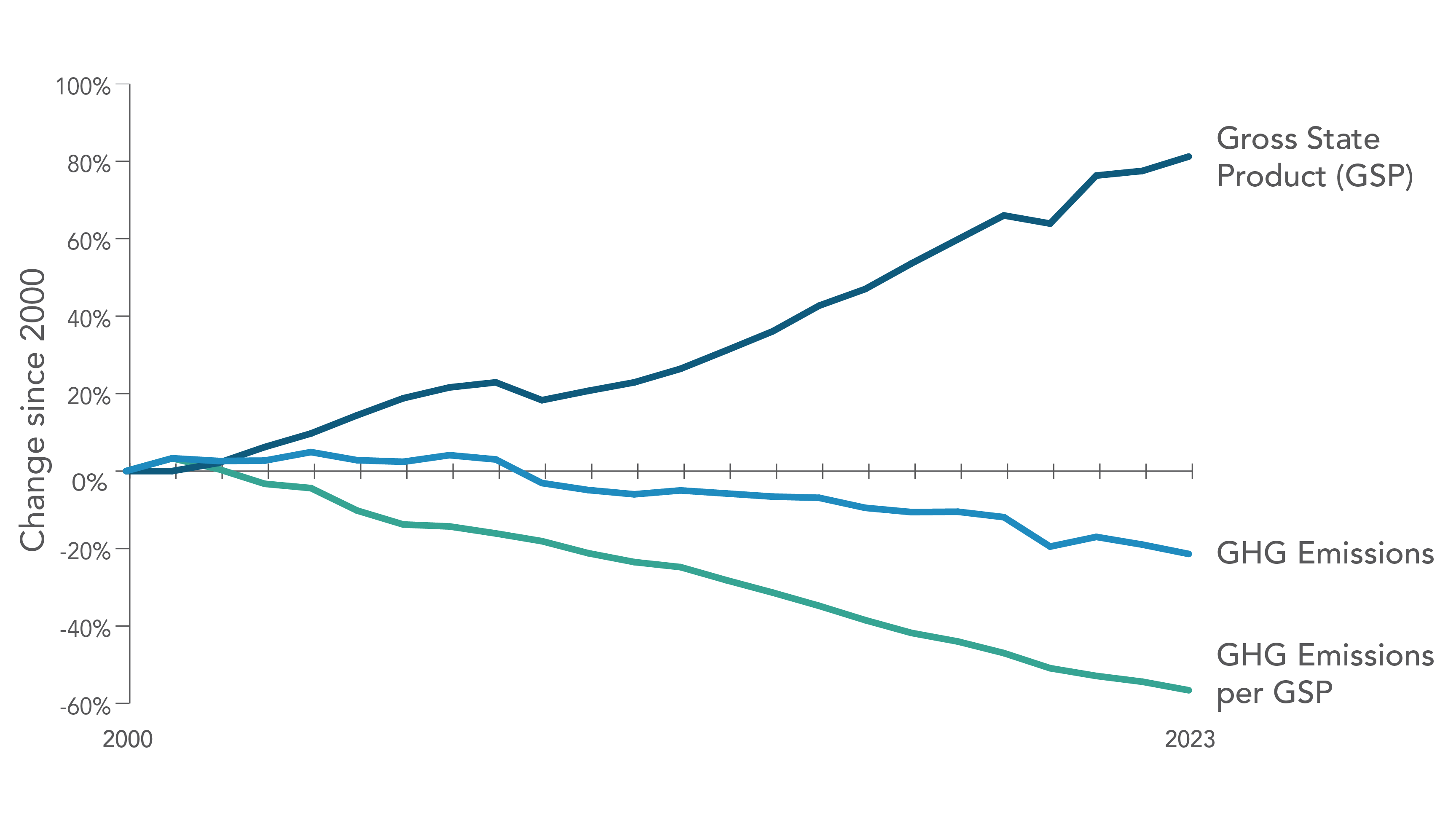
Change in California Gross State Product and GHG Emissions Since 2000

A line graph showing the percentage change in California’s GSP, GHG Emissions, and GHG Emissions per unit GSP in 2001 to 2023 relative to 2000. California’s GSP has increased almost every year since 2000. Since 2007, GHG Emissions and GHG Emissions per unit GSP have steadily decreased. For more information on data displayed, contact ghginventory@arb.ca.gov.

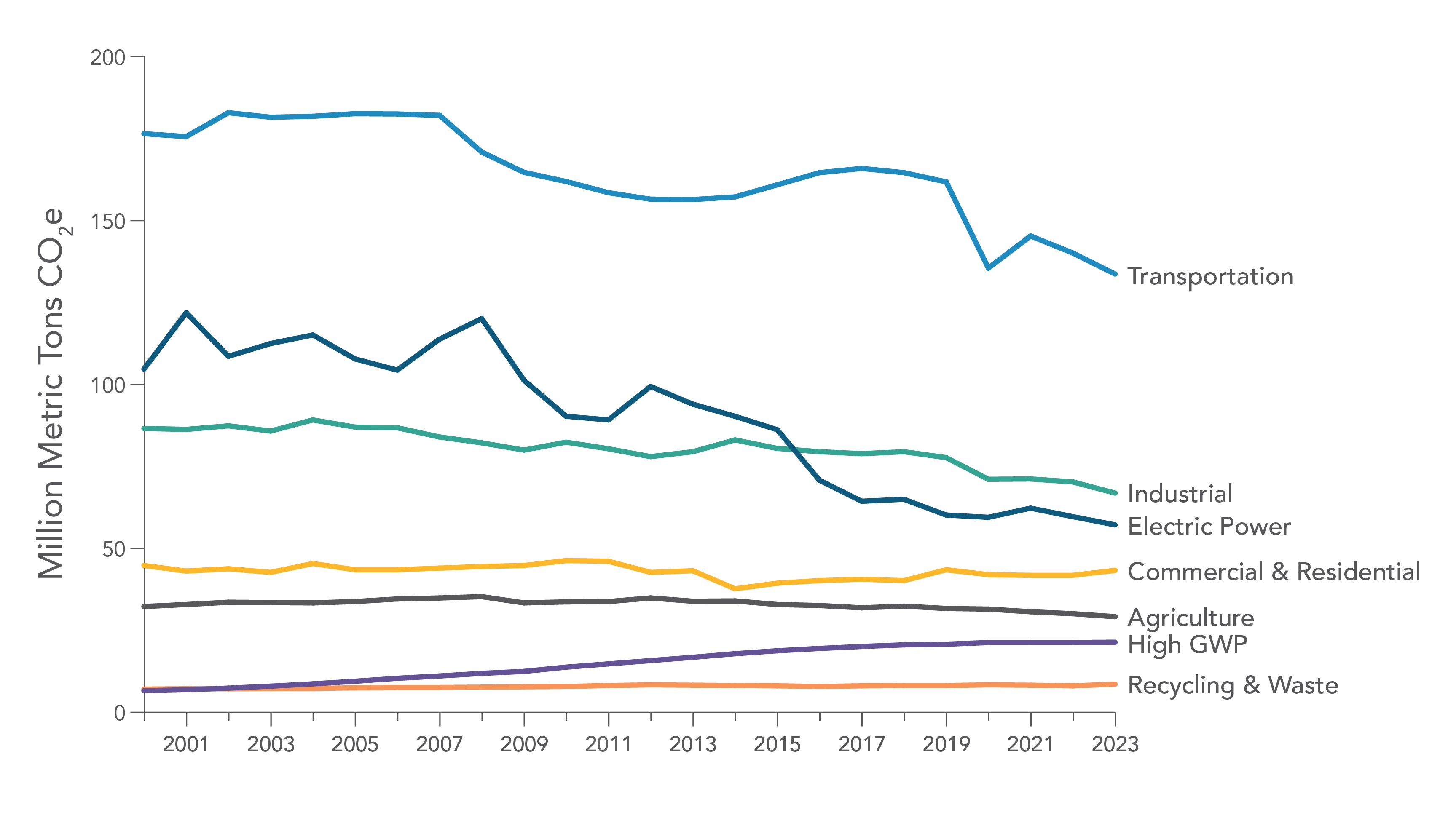
2000–2023 GHG Emissions by Category as Defined in the Scoping Plan

A line graph showing emissions trends by Scoping Plan sector from 2000 to 2023. Sectors are represented by the following lines: Transportation, Electric Power, Industrial, Commercial and Residential (combined), Agriculture, High GWP, and Recycling and Waste (combined). The transportation sector is the largest source of GHG emissions in the state in all years. The industrial sector is the next largest sector in 2023, followed by electric power, Commercial and Residential, Agriculture, High GWP, and finally R
Contact
Case Settlement
Off
Legislative Bill Tracking
Off
Division field is automatically filled by OIS on 06/21/2021
Off
Alternative Control Plan

The Alternative Control Plan (ACP) Requirements:

The California Air Resources Board (CARB) has adopted several regulations to reduce the amount of volatile organic compounds (VOCs) that are emitted from the use of consumer products in homes and institutions. The Consumer Products Regulations are found in Title 17, California Code of Regulations, Division 3, Chapter 1, Subchapter 8.5, Articles 1 through 5, Sections 94500-94575. The ACP must meet the specific requirements of sections 94540-94555 in Article 4 of the regulations.

Email your complete application and all questions concerning the ACP to Consumer Products Help.

Documents

Description

ACP Compliance Table Sample Report Attachment (Download Excel File)ACP Compliance Report sample table.
Application to Modify/Amend an Existing Alternative Control PlanApplication to add a product or to notify CARB of a change to an existing ACP.
Application to Establish a New Alternative Control PlanApplication form for a new ACP.
Case Settlement
Off
Legislative Bill Tracking
Off
Division field is automatically filled by OIS on 06/21/2021
On

Innovative Product Exemption

The Innovative Product Exemption (IPE) Requirements:

The California Air Resources Board (CARB) has adopted several regulations to reduce the amount of volatile organic compounds (VOCs) that are emitted from the use of consumer products in homes and institutions. The Consumer Products Regulations are found in Title 17, California Code of Regulations, Division 3, Chapter 1, Subchapter 8.5, Articles 1 through 5, Sections 94500-94575. The IPE must meet the specific requirements of section 94511.

Email your complete application and all questions concerning the IPE to CARB IPE Application.

DocumentsDescription
Innovative Product Exemption Application GuidanceInformative guidance document for the process of requesting an innovative product exemption.
Compressed Gas Propellant and Liquefied Propellant Innovative Product Exemption Application GuidanceInformative guidance document describing the process of requesting an innovative product exemption for compressed gas propellant and liquefied propellant products.
Application for Innovative Product ExemptionForm to be submitted to obtain an innovative product exemption with instructions attached.
Application for Compressed Gas Propellant and Liquefied Propellant Innovative Product ExemptionForm to be submitted to obtain an innovative product exemption for compressed gas propellant and liquefied propellant products with instructions attached.
Case Settlement
Off
Legislative Bill Tracking
Off
Division field is automatically filled by OIS on 06/21/2021
Off
Charcoal Lighter Material

Charcoal Lighter Material (CLM) Information:

CARB has adopted several regulations to reduce the amount of volatile organic compounds (VOCs) that are emitted from the use of consumer products in homes and institutions. The Consumer Products Regulations are found in Title 17, California Code of Regulations, Division 3, Chapter 1, Subchapter 8.5, Articles 1 through 5, Sections 94500-94575. A CLM must meet the specific requirements of Section 94509(h) in Article 2 of the regulations to be sold in California. 

Email your complete application and all questions concerning the CLM certification process to Consumer Products Help.

Documents

Description

Charcoal Lighter Material Application FormApplication to apply for Charcoal Lighter Material (CLM) certification through CARB.
Compiled List of CARB Certified Charcoal Lighter Material ProductsCARB certified CLM Products. (Last updated: April 16, 2024)
CARB Enforcement Division's Charcoal Lighter Material Advisory #316Summary of the regulatory requirements for CLM certification.
SCAQMD Rule 1174: Ignition Method Compliance Certification ProtocolUsed to determine whether a CLM meets the standards of the Consumer Products Regulation.
Case Settlement
Off
Legislative Bill Tracking
Off
Division field is automatically filled by OIS on 06/21/2021
Off

Informal Regulatory Activity for Board Hearing held on March 25, 2021

The California Air Resources Board (CARB) staff has developed proposed amendments to the Antiperspirants and Deodorants Regulation; Consumer Products Regulation; Aerosol Coating Products Regulation; Alternative Control Plan Regulation; the Tables of Maximum Incremental Reactivity Values; and Test Method 310 (Proposed Amendments) for Board consideration on March 25, 2021. 

Staff held five public workshops in support of the Proposed Amendments, on April 12, 2019, November 7, 2019, April 14, 2020, July 28, 2020, and November 10, 2020, and held 22 topic-specific public work group meetings to elicit public feedback in identifying and refining our regulatory proposals.  Information regarding these public meetings can be found below.  The following items are also known as "Informal Regulatory Activity." This means that the items below may or may not become part of the formal rulemaking process (i.e., they have not yet been presented to our Board for action).  CARB posted the Formal Rulemaking Documents for the Proposed Amendments on February 2, 2021, and the 45-day public comment period for the Proposed Amendments began on February 5, 2021. 


Consumer Product Regulations Amendments Public Workshop

The webinar was held at the date, time, and locations shown below:

DATE:Tuesday, November 10, 2020
TIME:9:00 a.m. – noon (PST)
MATERIALS:

At this final public workshop, staff discussed refinements to its draft regulatory proposals shared at the previous public workshop on July 28, 2020.  This included the following topics and information:

  • Proposed VOC standards for Manual Aerosol Air Freshener, Hair Care Categories (Hair Finishing Spray, Dry Shampoo, Hair Shine and Temporary Hair Color), Personal Fragrance Products, and Aerosol Crawling Bug Insecticide.
  • Proposed Sunset of the Two Percent Fragrance Exemption for most product categories;
  • Proposed Innovative Product Exemption criteria to encourage development of products using compressed gas propellant instead of HFC-152a in Hair Finishing Spray, Dry Shampoo, and Aerosol Personal Fragrance Products; and
  • Proposed amendments to the Energized Electrical Cleaner definition.

CARB staff thanks stakeholders for their participation in helping to develop and refine these draft regulatory proposals, and looks forward to bringing draft proposed Consumer Product Regulation Amendments to the Board for its consideration in February 2021.


Previous Consumer Products Program Public Work Group Meetings

Proposed Amendments to Energized Electrical Cleaner Definition

CARB staff invited interested stakeholders in the retail and wholesale automotive supply chain and automotive repair establishments of a webinar to discuss proposed changes to the Consumer Products Regulation. Staff proposed to modify the definition of the “Energized Electrical Cleaner” category to restrict sales of this product to Automotive Repair Establishments and by Automotive Parts and Accessories Stores.

“Energized Electrical Cleaners” are products labeled to clean and/or degrease electrical equipment where cleaning and/or degreasing is accomplished when electrical current exists, or when there is a residual electrical potential from a component such as a capacitor. The current consumer products regulations also require these products to be labeled with the statements “Energized Equipment use only. Not to be used for motorized vehicle maintenance, or their parts.”

Despite this definition and labeling requirement, a significant amount of energized electrical cleaner products containing toxic air contaminates (TACs) such as perchloroethylene and elevated levels of VOCs, are being sold by automotive parts and accessory stores, and to automotive repair establishments.

During the webinar, staff provided background information on the overall consumer products rulemaking process, the VOC and TAC emissions issues driving the Energized Electrical Cleaner staff proposal, and the proposal itself.  

DATE:October 29, 2020
TIME:9:00 a.m. - 12:00 p.m. (PDT)

MATERIALS:


Consumer Products Regulations Amendment Public Workshop

DATE:July 28, 2020
TIME:9:00 a.m. - 12:00 p.m. (PDT)

MATERIALS:

Staff presented its draft final proposed Consumer Products Regulations amendments at this public webinar, including CARB's proposals to set or lower VOC content limits for Hair Care Products (Hair Finishing Spray, Dry Shampoo, Hair Shine, and Temporary Hair Color), Personal Fragrance Products, Manual Aerosol Air Freshener, and Aerosol Crawling Bug Insecticide, as well as proposed regulatory changes to improve program implementation.


Proposed Sunset of Two-Percent Fragrance Exemption, Product Label Definition Update (to Include Web-Base Claims), and Energized Electrical Cleaner Definition Amendment

DATE:July 9, 2020
TIME:9:00 a.m. - 12:00 p.m. (PDT)
MATERIALS:

Presentation

At this webinar CARB staff described its proposals to: 1) sunset the two-percent fragrance exemption for most regulated product categories; 2) include product claims a manufacturer makes on its internet site in the definition of a product label for product classification purposes; and 3) update the definition of Energized Electrical Cleaner to address product purchase for off-label usage and reduce emissions of air toxics.


Proposed Test Method 310 Amendments and Associated Consumer Products Regulations Updates

DATE:July 2, 2020
TIME:9:00 a.m. - 11:00 a.m. (PDT)
MATERIALS:

At this webinar CARB staff discussed the proposed amendments to 'Method 310: Determination of Volatile Organic Compounds (VOC) in Consumer Products and Reactive Organic Compounds (ROC) in Aerosol Coating Products', and associated updates to the Consumer Product Regulation.


At this webinar CARB staff discussed the proposed Test Method 310 updates and related Consumer Product Regulation changes. For more information regarding this meeting, contact Mr. Keith Kennedy.

DATE:Monday, April 20, 2020
TIME:9:00 a.m. until 11 a.m. (PDT)


MATERIALS:


At this webinar CARB staff discussed the proposals to its development of the Consumer Products Regulation amendments.  

DATE:Tuesday, April 14, 2020
TIME:9:00 a.m. - noon (PDT)

MATERIALS:

If you have any questions about this webinar, contact Mr. Josh Berghouse.


DATE:Tuesday, March 10, 2020
TIME:9:00 a.m. – noon (PDT)
LOCATION:

CalEPA Conference Room 550
1001 I Street, Sacramento, CA 95814

MATERIALS:

At this webinar CARB staff discussed the proposed Regulatory Definitions Work Group Meeting to prioritize and discuss possible Consumer Product Regulation definition updates. This meeting focused on existing Consumer Product Regulation definition updates suggested by CARB and public stakeholders to improve program transparency, enforceability, and effectiveness. This Regulatory Definitions Work Group meeting was held in person at the following date and time.

DATE:Wednesday, February 26, 2020
TIME:9:00 a.m. – noon (PDT)
LOCATION:

CARB Conference Room MLD-North
1927 13th Street, Sacramento, CA 95811

MATERIALS:

At this webinar CARB staff discussed the development of proposed California Consumer Products Regulation amendments.  The workshop was held at the date and time shown below:

DATE:Thursday, November 7, 2019
TIME:9:00 a.m. – noon (PDT)
LOCATION:

California Air Resources Board
Byron Sher Auditorium, 2nd Floor
1001 I Street, Sacramento, CA 95812

MATERIALS:

Interested stakeholders were invited to participate in the next round of consumer product rulemaking work group meetings, during which CARB staff solicited stakeholder feedback on its draft policy and technical evaluations of key consumer product categories and topics areas. Three topic-specific meetings were held by webinar only, between September 20 and October 17, 2019. These four meetings were open to all interested stakeholders.

Date

Topics

Thursday, October 17

  • Aerosol Air Freshener
  • Laundry Detergent and Fabric Softener
  • Non-Aerosol Glass Cleaner
  • Aerosol Cooking Spray
  • Floor Wax Stripper
  • Paint Remover or Stripper
  • Aerosol Crawling Bug Insecticide
  • Charcoal Lighter Material
  • Hand Sanitizer

Presentation

Thursday, October 10

  • Hair Finishing Spray
  • Dry Shampoo
  • Aerosol Sunscreen
  • Mouthwash
  • Personal Fragrance Products with Less than 20% Fragrance
  • Anti-Perspirants and Deodorants

Presentation

Friday, September 20

  • Evaluation of Consumer Product Fragrance VOC Content
  • Discussion of HFC-152a Aerosol Propellant

Presentation

CARB staff conducted a Regulatory Definitions Work Group Meeting to prioritize and discuss possible Consumer Product Regulation definition updates.  This meeting focused on existing Consumer Product Regulation definition updates suggested by CARB and public stakeholders to improve program transparency, enforceability, and effectiveness.  This Regulatory Definitions Work Group meeting was held in person at the following date and time.

DATE:  October 4, 2019
TIME:9:00 a.m. - 12:00 p.m. (PDT)
LOCATION:

California Air Resources Board
Conference Room MLD South
1927 13th Street, Sacramento, California 95811

MATERIALS:

Meeting Handout

Regulatory Definitions Work Group Meeting

Staff welcomed and encouraged your participation in this effort to develop concise, transparent, and effective regulatory language for updates to the Consumer Products Regulation. We look forward to your feedback throughout the rulemaking process. If you have questions, contact Mr. Nicholas Berger, Air Pollution Specialist, at (916) 327-1516.

TIME:9:00 a.m. - 12:00 p.m. PDT
LOCATION:California Air Resources Board
Monitoring and Laboratory Division
First Floor Conference Room
1927 13th Street
Sacramento, CA 95811
MATERIALS:Regulatory Definitions Discussion

Background: The 2016 State Strategy for the State Implementation Plan requires CARB develop measures to reduce consumer product volatile organic compound (VOC) emissions by 1 - 2 tons per day (tpd) by 2023 and 4 - 5 tpd by 2031, respectively, in the South Coast Air Basin, and 8 -10 tpd by 2031 Statewide. At its April 12, 2019 public workshop to initiate rulemaking to meet these emission reduction commitments, CARB proposed to evaluate consumer product survey categories with more than 0.5 tpd VOC emissions as part of its rule development process. These initial work group meetings will be held by teleconference.

CARB also encourages interested stakeholders to meet individually with staff to discuss category-specific issues, emission reduction opportunities, and possible innovative regulatory approaches. CARB intends to utilize these meetings to propose specific categories and possible regulatory options for discussion at a second public workshop in Fall 2019, and to bring a regulatory proposal to the Board for its consideration in late 2020.

July 2, 2019
10 am - noon PDT
Topics:
  • Charcoal Lighter Material
  • Crawling Bug Insecticide
  • Nail Polish/Lacquer/Paint
  • Slides
June 27, 2019
10 am - noon PDT
Topics:
  • Aerosol Disinfectant
  • Nonaerosol Disinfectant
  • Hand Sanitizer
  • Anti-microbial Hand or Body Cleaner or Soap
  • Rubbing Alcohol
  • Slides
June 25, 2019
10 am - noon PDT
Topics:
  • Antipersperant
  • Deodorant
  • Deodorant Body Spray
  • Personal Fragrance Product with 20% or less fragrance
  • Slides
June 18, 2019
10 am - noon PDT
Topics:
  • Body Wash/Mousse/Gel/Soap/Foam/Scrub
  • General Use Hand or Body Cleaner or Soap
  • Hand and Body Conditioner, Cream, Lotion, or Moisturizer
  • Mouthwash/Rinse
  • Slides
June 13, 2019
10 am - noon PDT
Topics:
  • Mothballs
  • Denatured Alcohol
  • Paint Remover or Stripper
  • Scented Candle
  • Pet Care Products
  • Slides
June 11, 2019
10 am - noon PDT
Topics:
  • Brake Cleaner
  • Floor Wax Stripper
  • Automotive Windshield Washer Fluid (Type "A" Areas)
  • Windshield Washer Additive
  • Body Repair Products (other than coatings)
  • Slides
June 4, 2019
10 am - noon PDT
Topics:
  • Aerosol Sunscreen
  • Shampoo
  • Conditioner Without Styling Claims
  • External Analgesic Product
  • Topical Anti-Fungal Product
  • Slides
May 30, 2019
10 am - noon PDT
Topics:
  • General Purpose Cleaner (nonaerosol)
  • General Purpose Degreaser (nonaerosol)
  • Bathroom and Tile Cleaner (aerosol)
  • Glass Cleaner (aerosol)
  • Slides
May 28, 2019
10 am - noon PDT
Topics:
  • Air Freshener, Single Phase Aerosol
  • Air Freshener, Double Phase Aerosol
  • Dual Purpose Air Freshener/ Disinfectant (aerosol)
  • Air Freshener, liquid/pump spray
  • Air Freshener, solid/semisolid
  • Slides
May 22, 2019
10 am - noon PDT
Pacific Daylight Time (PDT)
Topics:
  • Laundry Detergent
  • Liquid Fabric Softener
  • Dish Detergent/Soap (manual)
  • Aerosol Cooking Spray
  • Slides
May 20, 2019
10 am - noon PDT
Pacific Daylight Time (PDT)
Topics:
  • Hair Finishing Spray
  • No Rinse Shampoo
  • Dye, Permanent
  • Slides
 

April 12, 2019 Workshop

To initiate rulemaking to achieve additional emission reductions from consumer products, CARB held a public workshop on April 12, 2019. Materials from this kickoff public workshop are posted below.

April 12, 2019 Workshop Notice
Workshop Presentation
Survey Data Summary and Findings
Appendix A: Survey Category VOC Histogram


Consumer Products Program - Rulemaking - Informal Activity

Hero Image
Case Settlement
Off
Legislative Bill Tracking
Off
Division field is automatically filled by OIS on 06/21/2021
Off