

California GHG Emissions Limits
The state of California is committed to achieving carbon neutrality by 2045 or earlier. California’s Assembly Bill 32 Greenhouse Gas Emissions Inventory (Inventory) is used to track progress towards the state’s 2020, 2030, and 2045 statewide GHG emissions limits. These GHG limits each require anthropogenic emissions to be reduced by a specific percentage of the 1990 level by a specified year. To achieve carbon neutrality by 2045, all residual emissions must be compensated for by carbon sinks. California plans to expand carbon sinks through actions to capture and store carbon in natural and working lands and a variety of mechanical approaches.
California's GHG Emissions and Limits
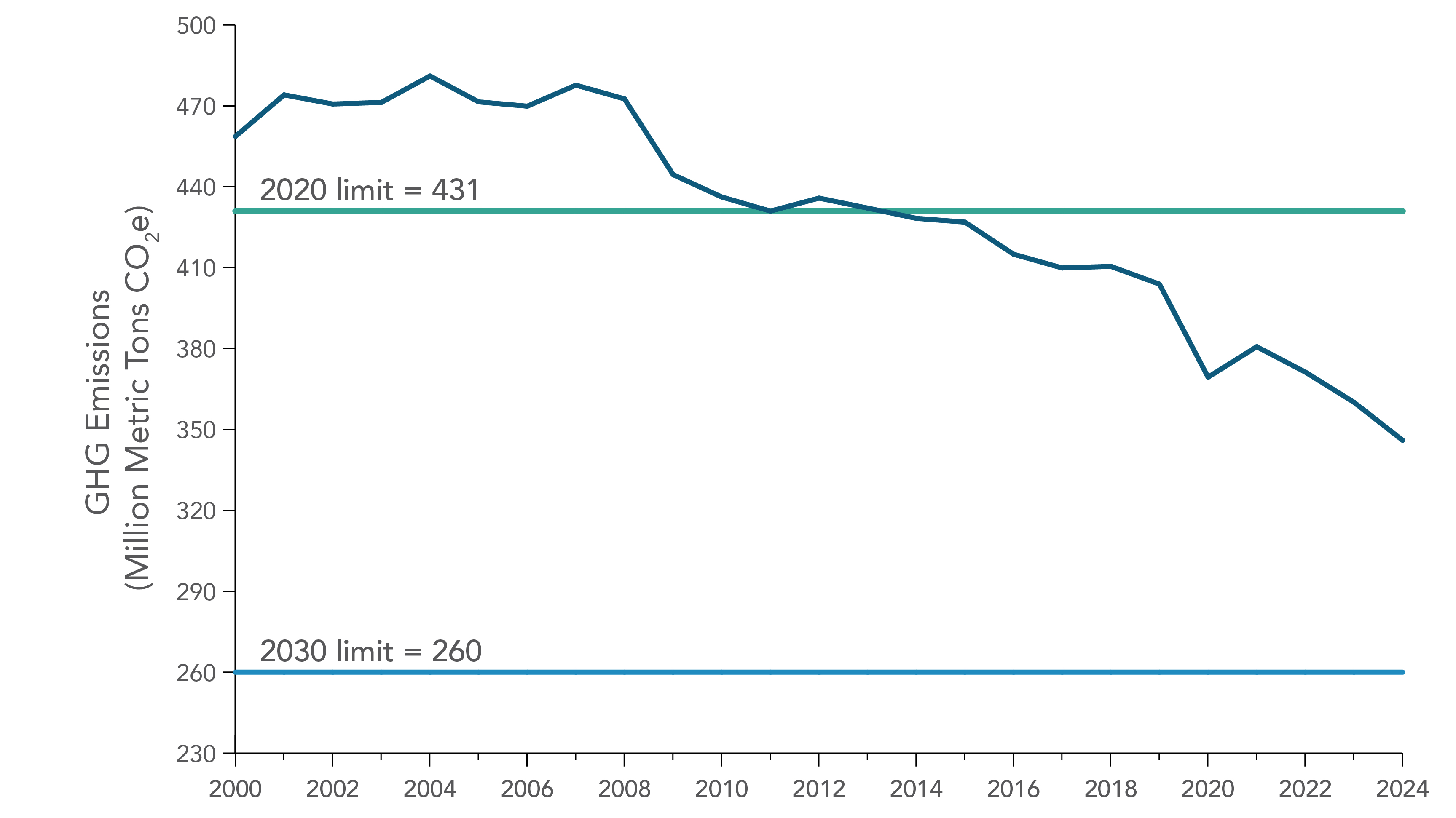
The sections below provide additional information about each limit and describe how the 1990 emissions level was determined.
Future Statewide GHG Emissions Limit and Carbon Neutrality
The California Global Warming Solutions Act of 2006: Emissions Limit (SB 32) (Pavley, Chapter 249, Statutes of 2016) requires California to reduce statewide GHG emissions to 40% below 1990 level by 2030. Further, the California Climate Crisis Act (AB 1279) (Muratsuchi, Chapter 337, Statutes of 2022) requires California to reduce statewide anthropogenic emissions to 85% below the 1990 level by 2045. AB 1279 also establishes the policy of the state to achieve carbon neutrality as soon as possible, but no later than 2045, and to maintain net negative GHG emissions thereafter. CARB's 2022 Scoping Plan Update assesses progress toward the 2030 limit, while laying out a path to achieving carbon neutrality no later than 2045.
2020 Statewide GHG Emissions Limit
The Global Warming Solutions Act of 2006 (AB 32) (Nuñez and Pavley, Chapter 488, Statutes of 2006) requires California to reduce statewide GHG emissions to 1990 levels – 431 million metric tons of carbon dioxide equivalent (MMTCO2e) – by 2020. California's GHG emissions dropped below the 2020 GHG Limit in 2014 and have remained below the limit since that time.
1990 Emissions Level
The 1990 emissions level, 431 MMTCO2e, is used as a baseline along with the corresponding legislatively-mandated percentage reductions to determine the statewide 2020, 2030, and 2045 GHG emissions limits.
In 2007, CARB staff developed an Inventory for the years 1990-2004 (2007 edition Inventory) in part to determine the 1990 emissions level. The original 1990 level of 427 MMTCO2e was based on Intergovernmental Panel on Climate Change (IPCC) Second Assessment Report global warming potentials (GWPs), and was approved by the Board in 2007. This original 1990 level was revised to 431 MMTCO2e in 2014 with Board approval, to use GWPs from the IPCC's Fourth Assessment Report. The Board materials associated with setting both the original and revised 1990 emissions levels are available at the links below.
Staff Presentation for Board: Original 1990 Level [pdf]
Board Meeting Archive: Original 1990 Level
Meeting Transcripts: Original 1990 Level
Public Comments Received: Original 1990 Level
Board Resolution: Original 1990 Level [pdf]
Board Resolution: Revised 1990 Level [pdf]
The staff report titled "California 1990 Greenhouse Gas Emissions Level and 2020 Emissions Limit" (available below) discusses the original development of the 1990 statewide emissions level and provides a summary of the key emissions sources, the methods used to calculate the emissions, and the sources of data.
Staff Report: California 1990 Greenhouse Gas Emissions Level and 2020 Emissions Limit [pdf]
Appendix A-1: Summary 1990 Inventory by IPCC Category [pdf]
Appendix A-2: 1990 Inventory by IPCC Category [pdf]
Appendix B: 1990 Carbon Flux Table and Diagram [pdf]
Appendix C: California Global Warming Solutions Act of 2006 [pdf]
Additional Resources
2007 Edition Inventory Data, Reports & Documentation
1990 GHG Inventory Query Tool