Public Workshop Webinar to Discuss the 2022 Edition of California’s 2000-2020 Greenhouse Gas Emissions Inventory
Air Quality Planning and Science Division
Formal Rulemaking Documents and Informal Activity
Formal Rulemaking Documents
- Past rulemakings regarding the Consumer Products Program
- These past rulemakings have reached the "Formal" rulemaking process.
Informal Regulatory Activity – Public Workshops and Meetings
Hero Image
Contact
Case Settlement
Off
Legislative Bill Tracking
Off
Division field is automatically filled by OIS on 06/21/2021
Off
Advanced Clean Equipment - Research Funded Projects by CARB
Off-Road Equipment Electrification
List of Zero-Emission Equipment Research Projects Funded by CARB
Related research projects and upcoming datasets from the ongoing activity data collection
CARB is conducting numerous research projects and discusses the research opportunity with the upcoming data survey deliverables from various ORE types. The obtained activity profiles will help numerous researchers understand activity patterns and capture emission characteristics of various ORE types.
Activity Data of Off-Road Engines in Construction (Contract Number: 17RD013)
This project aims to collect in-use engine activity data from various ORE types and assess and characterize the operating patterns of the ORE engines. The obtained real-world data includes engine control unit (ECU) parameters related to the internal combustion engine’s performance and air pollution control devices. For the given project period, the research team collected data from 54 pieces of construction equipment with nine different equipment types. The obtained data can be used to 1) estimate load factor (%) and improve the emission inventory, 2) identify operational and environmental characteristics of various off-road equipment types, and 3) assess the energy demand required and project electrification potential per type.
Hybridization and Full Electrification Potential in Off-Road Applications (Contract Number: 18RD016)
This research aimed to assess the electrification potential of various construction and similar equipment operating in California. The key findings of this study are: 1) Various alternative fuel types and equipment architectures were found across equipment types, 2) Each equipment type has different electrification progress depending on the research attention received, 3) The collected in-use operational data shows significantly different operating patterns from the certification cycles, 4) Analyses of the real-world activity and energy demand of selected equipment types reveal that equipment with the daily energy demand of under 500kWh could be electrified and deployed with a 50kW charging option, and 5) Replacement of older equipment is likely to be more cost-effective in terms of NOx and PM2.5 emission benefits because of their non-compliance to newer, more stringent emission standards.
Collection and Analysis of Agricultural Equipment Activity Data (Contract Number: 19RD002)
This research project will collect engine and after-treatment system performance data from up to 200 agriculture tractors’ Engine Control Unit (ECU). The project will characterize how agricultural engines in the San Joaquin Valley operate under actual working conditions, including their activity parameters (e.g., engine speed, torque, and fuel rate) and maintenance frequency, crop and land types of agricultural operation performed, hours of operation, and cost. The results can be used to improve the emission inventories and to inform policies and incentive programs for off-road engines and equipment.
Full Cost Analysis and Business Case Study of Off-Road Zero-Emission Equipment (Contract Number: 21MSC006)
The goals of this project are 1) performing a full cost analysis of battery-electric and fuel cell technology in the ground off-road equipment sector and 2) analyzing the 175 horsepower under business case for manufacturers and operators of ZE ORE. The research team will estimate equipment production potential for each equipment type based on various measures, such as the performance of the ZE powertrain compared to the diesel counterparts, operational changes, availability of component suppliers, maintenance/fuel cost, etc.
Case Settlement
Off
Legislative Bill Tracking
Off
Division field is automatically filled by OIS on 06/21/2021
Off
Advanced Clean Equipment - Financial and Regulatory Programs
Off-Road Equipment Electrification
List of Advanced Clean Equipment List
List of Zero-Emission Equipment Research Projects Funded by CARB
List of Related Financial and Regulatory Programs
California Policy Drivers
The following policy drivers will facilitate the electrification in off-road sectors and provide fundamental justifications for the state’s electrification strategies and implementation plans.
Table 1. California Policy Drivers
California Policy | Goals and Requirements |
Senate Bill 1389 (2002) | SB 1389 requires the CEC to prepare the Integrated Energy Policy Report (IEPR) biennially. The report presents CEC’s integrated assessment results about the state’s energy issue and provides policy recommendations to conserve resources, facilitate a sustainable energy supply chain, and protect the environment. |
Assembly Bill 32 (2006) | AB 32, or the Global Warming Solutions Act of 2006, requires California to reduce GHG emissions to 1990 levels by 2020. AB32 directs CARB to adopt regulations to achieve the maximum technologically feasible and cost-effective GHG emission reductions. The Low Carbon Fuel Standard (LCFS) program was one of CARB’s nine discrete early action measures to reduce California’s greenhouse gas (GHG) emissions that cause climate change. |
Senate Bill 350 (2015) | The Clean Energy and Pollution Reduction Act (SB 350) requires the California Energy Commission (CEC) to establish annual targets statewide, including reduction of GHG emissions to 40 percent below 1990 levels by 2030 and to 80 percent below 1990 levels by 2050. |
Senate Bill 32 (2016) | SB 32 mandates the reduction of greenhouse gas (GHG) emissions to 40% below 1990 levels by 2030. CARB is responsible for ensuring that California meets this goal. This air quality agency publishes an Update to the Scoping Plan every five years, detailing how CARB plans to meet emission reduction targets. |
Assembly Bill 617 (2017) | CARB’s Community Air Protection Program aims to reduce exposure in communities highly impacted by air pollution in response to AB 617. The state agencies and local air districts are collaborating on various efforts to implement innovative air quality improvement strategies and reduce health impacts. |
Senate Bill 100 (2018) | SB 100 mandates the state to achieve 100% renewable and carbon-free electricity by 2045 and 60% renewable electricity by 2030. |
Assembly Bill 3232 (2018) | AB 3232 requires the CEC to assess the potential to reduce the emissions of GHG emissions from residential and commercial buildings by at least 40 percent below 1990 levels by 2030. |
Executive Order B-55-18 (2018) | EO B-55-18 sets a goal for the entire California economy to achieve carbon neutrality by 2045 and achieve and maintain net harmful emissions thereafter. |
Executive Order N-79-20 (2020) | EO N-79-20 aims to achieve 100% zero-emission vehicles (ZEV) for passenger cars, light-duty trucks, and drayage vehicles by 2035 and medium and heavy-duty vehicles by 2045. More importantly, it directs CARB to develop and propose “strategies, in coordination with other State agencies, U.S. EPA and local air districts, to achieve 100 percent zero-emission from off-road vehicles and equipment operations in the State by 2035”. |
Senate Bill 44 (2021) | SB 44 recognizes California’s continuous efforts needed to reduce on- and off-road sector emissions and requires CARB to update the Mobile Source Strategy (MSS) every five years. MSS will be translated into State Implementation Plans (SIP), demonstrating how the state will attain the standards by specified dates. It is also incorporated into Climate Change Scoping Plan and Community Emissions Reduction Plans (CERPs). |
CARB and other clean air agencies have put tremendous efforts into reducing criteria pollutants and greenhouse gas emissions. Numerous air quality improvement strategies and regulations have affected the off-road equipment (ORE) fleet mix and will make the fuel transitions across all off-road sectors and horsepower ranges. An ORE electrification plan must consider the interactions with the existing and future regulations.
Table 2. California Air Quality Improvement Strategies, Programs, and Regulations
Regulations and Programs | Description (Goals and Requirements) |
Heavy-Duty Three-Year Plan of Low Carbon Transportation Investments and Air Quality Improvement Program | This long-term investment plan is a funding roadmap for the heavy-duty vehicle and equipment sectors. It provides a total of $3.9 billion to multiple State agencies for the three fiscal years to accelerate ZEV sales and ZEV infrastructure network expansion. $2.3 billion is allocated to CARB, and it will support numerous air quality and climate goals and provide benefits to disadvantaged communities. |
Low Carbon Fuel Standard (LCFS) and LCFS Electricity and Hydrogen Provisions | The LCFS Program is a critical component of CARB’s efforts to reduce life cycle GHG emissions and other smog-forming and toxic air pollutants. It aims to decrease the carbon intensity of California’s transportation fuel inventory and promote the use of renewable energy and low-carbon fuel types. The LCFS Electricity and Hydrogen Provisions grant incentives to entities using hydrogen or electricity as a transportation fuel. Using hydrogen to produce other transportation fuel is also eligible for LCFS credits. |
2022 Scoping plan | California Global Warming Solutions Act, Assembly Bill 32 (AB 32), created a GHG emissions reduction program in 2006. Based on the identified advanced clean technologies available, this multi-year program offers a comprehensive climate change scoping plan targeting GHGs reduction by at least 40 percent below 1990 levels by 2030 and achieving carbon neutrality by 2045. CARB updates the plan every five years, and the 2022 Scoping Plan is the third version of the roadmap for the State of California’s efforts to reduce emissions and build resilient communities. |
California Clean Off-Road Equipment Voucher Incentive Project - Construction (CORE-Con)
| The Clean Off-Road Equipment Voucher Incentive Project (CORE) is a first-come, first-served voucher program for off-road equipment that began funding equipment in 2020. It is part of California Climate Investments, a statewide initiative allocating billions of Cap-and-Trade dollars to 1) reduce criteria pollutants and greenhouse gas emissions, 2) strengthen the economy, and 3) improve public health and the environment. CORE-Con has been built upon the CORE program and aims to promote the deployment of zero-emission technology in the off-road sector, including various construction, mining, and other equipment types. CORE voucher amounts are tailored by the cost premium of new zero-emission alternatives over traditional equipment. Additional funding is available for charging infrastructure and equipment deployed in pollution-overburdened and low-income AB 1550 communities. |
Funding Agricultural Replacement Measures for Emission Reductions (FARMER)
| The Funding Agricultural Replacement Measures for Emission Reductions (FARMER) program aims to reduce agricultural sector emissions by providing grants, rebates, and other financial incentives for various agricultural equipment and has successfully funded the adoption of electric utility task vehicles (UTVs). |
Carl Moyer Memorial Air Quality Standards Attainment Program
| The Carl Moyer Memorial Air Quality Standards Attainment Program (Carl Moyer Program) has granted approximately $1 billion in monetary incentives to replace older polluting engines in California. The program aims to reduce emissions from heavy-duty on-road and off-road equipment that qualify for Moyer grants. Thirty-five local air districts in California are currently participating. The program covers a variety of vehicle and equipment types, such as on-road trucks over 14,000 lbs. gross vehicle weight, construction, marine vessels, locomotives, stationary agricultural equipment, forklifts, light-duty vehicles, airport ground support equipment, lawn and garden equipment, and emergency vehicles. |
Community Air Protection Incentives | As of May 2022, 964 million dollars of Community Air Protection Incentives have been spent on the California communities most heavily impacted by disproportionate levels of air pollution since 2017. AB 617 directs local air districts spend funds through the two existing mobile source incentive programs, The Carl Moyer Memorial Air Quality Standards Attainment Program and the Proposition 1B Goods Movement Emission Reduction Program. Additional guidelines are that at least 70 percent of the funds must be spent on projects within and benefiting disadvantaged communities, and at least 80 percent of funds must be spent on projects within and benefiting a combination of disadvantaged and low-income communities. |
Case Settlement
Off
Legislative Bill Tracking
Off
Division field is automatically filled by OIS on 06/21/2021
Off
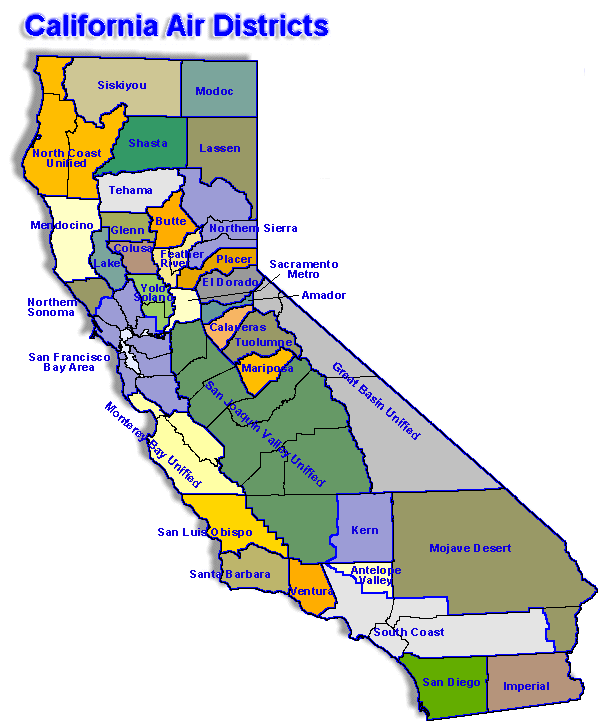
California Map for Local Air District Websites
California's 35 local Air Districts are responsible for regional air quality planning, monitoring, and stationary source and facility permitting. The districts administer air quality improvement grant programs and are CARB's primary partners in efforts to ensure that all Californians breathe clean air.
ARB Classic URL