
Frequently Asked Questions on the Alternative Diesel Fuel Regulation
California Code of Regulations, title 13, sections 2293-2293.9
Introduction: The Air Resources Board adopted the Regulation on the Commercialization of Alternative Diesel Fuels (ADF), found at California Code of Regulations (CCR), title 13, sections 2293-2293.9 (ADF Regulation), which became effective January 1, 2016. The regulation establishes a comprehensive, multi-stage process governing the commercialization of new ADFs in California. The regulation also establishes specifications and in-use requirements (such as using a NOx reduction additive) for biodiesel, as the first ADF subject to the ADF Regulation.
This document is intended to assist regulated parties with complying with the ADF Regulation reporting and recordkeeping requirements. This document is available on the ADF website.
For more information on the ADF Regulation, please contact the ADF Email.
1. Does the ADF Regulation apply to me?
The ADF Regulation contains reporting and recordkeeping requirements (section 2293.8) applicable to entities in the biodiesel industry, effective January 1, 2016. Biodiesel producers, importers, and blenders are required to report and keep records concerning biodiesel production, sales, and blending. On the other hand, biodiesel distributors and retailers are only required to keep records. On January 1, 2018, the biodiesel in-use requirements became effective, but prior to January 1, 2018, the ADF Regulation required only reporting and recordkeeping for biodiesel. For more information, please see the ADF Regulation.
2. Does the ADF Regulation apply to both on and off-road vehicle fuel?
Yes, section 2293.1(a) states that the ADF Regulation applies to any alternative diesel fuel, including on and off-road fuel.
3. Is renewable diesel subject to the ADF Regulation?
No, renewable diesel (also called renewable hydrocarbon diesel) is not subject to the ADF Regulation. The ADF Regulation defines an ADF as, among other things, a fuel that does not consist solely of hydrocarbons. Renewable diesel consists solely of hydrocarbons, and is therefore considered diesel rather than an ADF. Renewable diesel is subject to the diesel regulations at CCR, title 13, sections 2281-2285.
4. Are biodiesel blends above B20 considered commercial Stage 3 fuels under the ADF Regulation?
No, biodiesel blends above B20 are not Stage 3 fuels under the ADF Regulation. The ADF Regulation contains specifications for B100 blendstocks, but does not contain provisions for biodiesel blends above B20 as a finished fuel. Blends above B20 have not met the requirements of consensus standard adoption, engine manufacturer approval, or development of emissions protective fuel specifications or in-use requirements under the phase-in requirements of section 2293.5. Biodiesel blends above B20 must therefore go through the phase-in requirements of section 2293.5, including applying for a Stage 1 Pilot Program prior to sale.
5. For purposes of reporting and recordkeeping, is the “blender” considered the owner of the fuel at the time of blending, or the operator of the blending equipment?
The blender is the person that operates the equipment that is used to perform the blending. This person is responsible for satisfying the reporting and recordkeeping requirements for blenders under section 2293.8. It is CARB’s understanding that, under current blending practices, the blending equipment will likely either be a terminal, in the case of rack blending (including tank, in-line blending, or sequential blending), or a tank trailer, in the case of splash blending. All fuel blenders are required to keep complete records under the Motor Vehicle Fuels Distributor Certification Program (MVFDCP) and the ADF Regulation requires that the record be submitted by blenders and keep the record for five years. Please see Question 22 for more information.
6. What are some examples of producers, importers, blenders, distributors, and retailers?
Any particular regulated party may be subject to the reporting and recordkeeping requirements of more than one category in section 2293.8 and therefore is responsible for compliance with the requirements of each applicable category. The following list only provides examples of persons subject to the ADF Regulation. To determine whether the regulation applies to a particular person, please consult the ADF Regulation.
Producers: An example of a producer is a person who produces vehicular alternative diesel fuel in California.
Importers: An example of an importer is a person who buys an ADF or ADF blend from another state or another country and introduces the ADF or ADF blend into California for use in-State.
Blenders: An example of a blender is a person who blends an ADF with another fuel.
Distributors: An example of a distributor would be a person who transports an ADF or ADF blend without changing its blend level or composition.
Retailers: An example of a retailer would be a person who sells an ADF or ADF blend to end users.
7. When reporting feedstock, may the Low Carbon Fuel Standard (LCFS) mixed feedstock guidance be used?
No, the ADF Regulation requires that biodiesel producers, importers, and blenders report the monthly volume of neat ADFs produced, imported or obtained by feedstock. The reported biodiesel feedstock must match the actual feedstock rather than environmental attributes of the fuel being reported. In order to satisfy this requirement, cetane number or saturation level of a batch should be used as shown in Table A.2 and below.
| Biodiesel Saturation Level | Unadditized Cetane Number | Test Method |
|---|---|---|
| Low Saturation | <56 | ASTM D613-14; or ASTM D6890-13be1 |
| High Saturation | ≥56 | ASTM D613-14; or ASTM D6890-13be1 |
8. What should be reported if the saturation level of the feedstock is unknown?
If the saturation level (e.g., high or low) of the feedstock is unknown, low saturation level may be used as the default saturation level in lieu of the required testing to determine the actual cetane number.
9. Does Carbon Intensity (CI) pathway information need to be added to product transfer documents (PTD) in response to the ADF Regulation?
No, the ADF Regulation does not require adding CI pathway information to PTDs. The ADF Regulation reporting provisions do not require submission of any CI pathway information. However, the ADF Regulation recordkeeping provisions for Stage 3A fuels, which includes biodiesel, require that producers, importers, blenders, distributors, and retailers keep PTDs for a minimum of five years and requires retention of CI pathway information that may be included on those PTDs. A PTD prepared to comply with the LCFS recordkeeping requirement should contain most or all of the information required under the ADF Regulation.
10. Do blenders of B5 need to report their B5 blending?
Yes, the ADF Regulation requires that all biodiesel blends of B20 and below are subject to the reporting requirements in section 2293.8 and Appendix 1 of the ADF Regulation. It is important for enforcement purposes that all blends of biodiesel be reported. Please see Questions 16 and 17 for more information.
11. Can blenders report their biodiesel blend levels as ranges?
Yes, the most strict compliance option for the ADF Regulation is to use an additive for blends B6 to B20 in accordance with Table A.5 in Appendix 1. This table includes blend ranges for additive use, and blenders may report their blends as ranges consistent with the ranges in this table. However, biodiesel that is reported as a blend range will subsequently be treated as having a blend level at the top of the range, unless the fuel is tested to determine its exact blend level. Please see Question 12.
| Biodiesel Saturation Level | Biodiesel Blend Level |
|---|---|
| Low Saturation | B5 and below |
| >B5 to <B10 | |
| B10 to <B15 | |
| B15 to B20 | |
| High Saturation | B5 and below |
| >B5 to <B10 | |
| B10 to <B15 | |
| B15 to B20 |
12. Are blenders responsible for accurate blending and reporting of biodiesel that they blend?
Yes, it is each blender’s responsibility to confirm the blended amount and accuracy of the blend levels that are reported. For example, if a blender wishes to add biodiesel to fuel that may already contain up to five percent biodiesel, but the precise blend level is not known, the blender must either test the fuel to determine its actual blend level or assume the fuel contains five percent biodiesel prior to blending.
13. Is there a specific form available for reporting?
Yes, staff developed a reporting form to help regulated parties with organizing and reporting the information to comply with the ADF reporting requirements. The form is available on the ADF Reporting webpage.
14. When are quarterly reports due?
Under section 2293.8(a)(1), quarterly reports must be submitted by the end of the subsequent reporting period. For example, first quarter reports (January 1 through March 31) are due by June 30.
15. To whom should ADF reports be submitted, and is email or paper preferred?
Please send quarterly reports electronically (preferred) to the ADF Email or by mail to:
Oil and Gas and GHG Mitigation Branch Chief
1001 I St. P.O. Box 2815
Sacramento, California 95812
16. Is it necessary to fill out all tables in the ADF reporting form for B5 blenders?
Yes, although the information in Tables 2 and 3 appear similar, they are different and apply to all biodiesel blenders. For example, Tables 2.1 and 2.2 include the volume of blends produced, whereas Tables 3.1 - 3.4 includes the volume of blends supplied. This information is needed to track the blendstock and all blends of finished fuel volume produced and supplied during each month. If the entire volume of blends produced was supplied during the same month, it may be as simple as entering the same information in both Tables 2 and 3 for that month. Tables 1, 2, and 3 apply to all blenders including B5 and below blenders.
17. Is the purchaser’s information for blends B5 and below in Table 3.1 required to be reported?
Yes, downstream purchaser’s (e.g., end users and retailers) information for biodiesel blends B5 and below is required to be reported. In addition, blends that do not include NOx control (B5 year-round, B10 November through March) are also required to report the downstream purchaser information.
18. Is the purchaser’s information for blends above B5 in Tables 3.2 - 3.4 currently required to be reported?
Yes, downstream purchaser’s information for biodiesel blends above B5 are required to be reported. Effective January 1, 2018, biodiesel blends above B5 are subject to in-use requirements depending on the feedstock and month, and the downstream purchaser’s information will need to be tracked and reported at that time.
19. We have multiple facilities where we blend up to B5. Can we report the total aggregate B5 produced from all the blending facilities instead of by facility?
No, an operator of multiple blending facilities may not report the total aggregate blend (e.g., B5) produced from all blending facilities. Each blending facility is considered an individual blender, and each blender must report separately.
20. Is producing B99 from B100 considered blending?
No, the ADF Regulation treats B99 and B100 the same and does not consider this blending. Reporting of this action is not necessary.
21. Can a person in the state still purchase and sell B100 or B99?
Yes, purchase and sale of biodiesel blendstocks higher than B20 is allowed. However, those sales may not be retail sales for end use in engines, unless the selling entity has applied for and received an approved Executive Order as part of the 3 stage phase in process.
22. Are biodiesel blenders still required to register under the Motor Vehicle Fuels Distributor Certification Program (MVFDCP)?
Yes, biodiesel blenders must continue to comply with the MVFDCP. The MVFDCP is required by statute and requires that any motor vehicle fuels distributor who conducts business within the State of California must register with the ARB as a fuel distributor (Health and Safety Code Section 43025-43031.5). The MVFDCP’s distributor definition largely overlaps with the blenders and distributors under the ADF Regulation.
The MVFDCP requires that all vehicle fuel distributors maintain complete records of each purchase, delivery, or supply of motor vehicle fuel for a period of no less than two years in the physical locations reported pursuant to the subdivision. A complete record for each delivery is required to consist of no less than a copy, or the information contained therein, of the bills of lading from the refiner or bulk terminal from which the fuel is received, the delivery ticket or receipt showing the location of the fuel at the time of sales, and the invoice showing the purchaser of the fuel. The recordkeeping provisions of the ADF Regulation largely overlap with the MVFDCP, however the ADF Regulation requires records retention for 5 years.
23. Who are distributors and are they required to report?
Distributors in the ADF Regulation include those known in the industry as traders, common carriers, and jobbers that may or may not own the fuel title. Distributors generally transport fuels from upstream suppliers to the next downstream purchasers from the refinery or bulk terminal or import facility to motor vehicle fuel retailers. Distributors do not change a fuels formulation, composition, or blend level (other than producing B99 from B100). Distributors are not required to report but are required to keep records (generally the product transfer document or bills of lading) for a minimum of 5 years. The ADF Regulation section 2293.8(c)(3)(D) contains the Stage 3A ADF recordkeeping requirements applicable to biodiesel.
24. How is the saturation level of a biodiesel blend determined when high and low saturation fuels are blended in a tank?
When high and low saturation fuels are blended, the mixture must be tested for saturation level if it is still to be labeled as high saturation. Otherwise, it may be downgraded to low saturation without testing. High saturation biodiesel blends up to B10 do not need in-use requirements to address NOx once the NOx control levels became effective in January 2018.
Additional FAQs (added November 2017)
Effective January 1, 2018, the ADF Regulation requires implementation of the biodiesel in-use requirements. These in-use requirements mitigate potential increases in NOx emissions from the use of higher biodiesel blends. In addition to the reporting requirements currently in practice, the method of NOx mitigation and the volume mitigated must be reported when implemented by any parties, including producers, importers, or blenders. The reporting form was revised to include the in-use requirements information effective January 1, 2018.
25. What is a Pollutant Control Level and what is it for biodiesel?
A pollutant control level is the blend level of an ADF above which increases in one or more criteria pollutants have been found compared to CARB diesel that must be mitigated. Biodiesel is currently the only ADF with an established pollutant control level, and the pollutant of concern is NOx, therefore a NOx control level exists for biodiesel. The NOx control level for biodiesel is in the ADF Regulation Section 2293.6(a)(2) and shown in graphical format below. Biodiesel blends above the NOx control level are subject to in-use requirements.
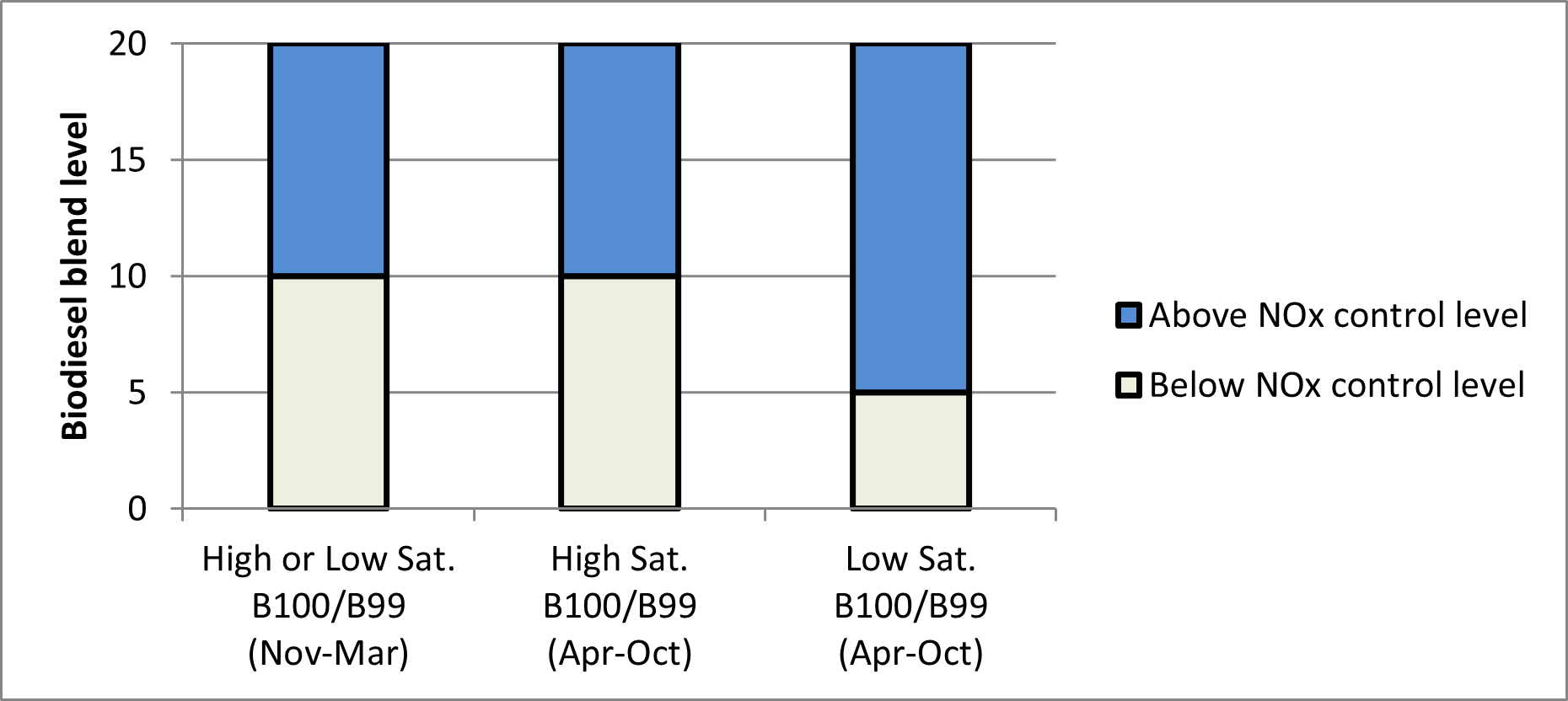
26. What are the available NOx control methods to comply with the biodiesel in-use requirements?
The available NOx control methods are listed in the ADF Regulation, Appendix 1 and under executive orders posted at the ADF Executive Orders webpage. The NOx control methods include two additives: Di-tert-butyl peroxide (DTBP), and VESTA 1000. Staff have also received numerous applications for fuel or additive certifications under the ADF Regulation and will post the applicable executive orders if and when those fuels or additives are certified.
27. Who is responsible for applying the NOx control method?
The ADF Regulation requires that all final blends distributed to end users meet the in-use requirements, and blends above the NOx control level must be mitigated before being sold or supplied to end users. Producers or importers may supply either NOx mitigated or unmitigated B100/B99, or both. However, whether the B100/B99 is mitigated must be indicated on the invoice or product transfer document accordingly. Blenders may not supply blends of B20 or below to end-users unless those blends are mitigated or blended below the NOx control level. All the above information is required to be included in the producers, importers, and blenders reporting forms. The reporting form tracks whether applicable blends are properly NOx mitigated or blended below the NOx control level before sold or supplied to the end users.
28. Are there any exemptions from the in-use requirements?
Yes. The ADF Regulation includes three exemptions from the biodiesel in-use requirements. The exemptions included in the ADF Regulation apply to fleet fueling facilities, retail fueling stations, and small volume producers and importers who meet certain criteria. As of November 2017, no one has applied for or been granted any of the exemptions.
The small volume producers and importers exemption is no longer available because the deadline to apply for that exemption, January 1, 2017, has passed. However, operators of fleet fueling facilities and retail fueling stations may still apply for an exemption. Please see section 2293.6(a)(5) for in-use exemption application requirements.
29. Are there additional recordkeeping requirements effective January 1, 2018?
Yes. Effective January 1, 2018, invoices or product transfer documents must specify the NOx control method used and must be retained for at least 5 years. The ADF Regulation section 2293.8(c)(3)(D) contains stage 3A fuels recordkeeping requirements.
30. When will the revised reporting form be available?
The reporting form will be available online prior to January 1, 2018. An email update will be sent out when the form is posted on the ADF website. Please sign up for email updates at the ADF website.
31. What frequency of testing is required to determine biodiesel saturation?
Producers and importers claiming a high saturation biodiesel must test their biodiesel for cetane once a month. Each B100/B99 blendstock storage tank must be tested and such testing must be representative of overall biodiesel produced or imported.
32. How can blenders ensure that finished fuel meets the in-use requirements?
Blenders can ensure that the finished fuel produced meets the in-use requirements in one of three ways: 1) Obtain NOx mitigated B100/B99 (or intermediate blends such as B50), or 2) Apply a NOx control method during blending, 3) Produce blends below the NOx control level. This information will need to be indicated on both the invoice or product transfer document and the reporting form. Biodiesel blends that are below the NOx control level are not subject to NOx mitigation.
33. How must additive concentration be calculated for NOx control additives?
Additive concentration is calculated based on the total fuel volume prior to adding additives. Below is the equation blenders should use when calculating the amount of additive needed to meet the in-use requirements.
Additive Volume to meet the Volume Percent, Minimum (always round up):
𝑋 = 𝑌 × 𝑍
Where:
X = Additive Volume (gallons) needed to meet the Volume Percent
Y = Final Blend Volume (gallons of CARB diesel (B0) and B100 combined)
Z = % additive required /100 (% additive required can be found in tables in the applicable executive order for certified additives or in Appendix 1 (a)(1)(A) for DTBP)
34. Can two mitigated biodiesel blends be comingled even if their mitigation methods were different?
Yes. Any mitigated biodiesel blends or blendstocks that contain NOx control methods can be comingled and retain their status as mitigated.
35. What B100/B99 reference fuel properties must be met for NOx control certification?
Table A.8, Biodiesel Additive Certification Fuel Properties, Appendix 1 in the ADF Regulation, contains the fuel properties of the blendstock. Please note that the viscosity range listed in a previous version of Table A.8 was a typo. The range should be 1.9 - 6.0 cSt, not 2.0 - 4.1 cSt.
36. What CARB diesel reference fuel properties must be met for NOx control certification?
The reference CARB diesel must meet the specifications in Table A.9 of Appendix 1 in the ADF Regulation, must be produced using normal refinery processes, including distillation and hydrotreating, but not cracking, and must not include any chemical blendstocks. Please note that the Polycyclic Aromatic Content, Weight % listed in a previous version of Table A.9 is a typo. It should be 1.4% maximum, not 10% maximum.
37. Can I use the DDC series 60 engine for NOx control certification testing after December 31, 2017?
Yes. Currently the deadline to switch the certification engine from the DDC series 60 to the Cummins ISM is December 31, 2017. Due to stakeholder feedback and for the sake of fairness to all applicants, CARB is extending this deadline to June 30, 2018. This means that all certification testing using the DDC series 60 engine must be complete by June 30, 2018, at the latest. Please note that the Cummins ISM engine may be used for testing at any time prior to and after June 30, 2018.
Addition FAQs (added July 2021)
In 2020, California Air Resources Board (CARB or Board) staff proposed amendments to the ADF Regulation to improve the rigor and clarity of the regulation. The adopted amendments became effective on May 3, 2021.
The responses to questions below will assist biodiesel fuel producers, blenders, and distributors in understanding the 2020 ADF Regulation amendments and associated compliance options. For reference, all ADF Regulation rulemaking documents are available at Amendments to the Regulation on the Commercialization of Alternative Diesel Fuels.
For more information on the ADF Regulation, please contact the ADF Email.
38. Why were the 2020 ADF Regulation amendments proposed?
The main objective of the 2020 ADF Regulation amendments was to ensure that the process for certification of additives or alternative diesel fuel formulations is uniform and provides assurance that those additives or formulations that pass emissions testing are effective at mitigating the potential NOx emissions from the use of the biodiesel.
39. What are the specific amendments that biodiesel producers and blenders should be aware of to comply with the ADF in-use requirements?
More stringent testing procedures were proposed in Appendix 1 of Subarticle 2. In-use Requirements for Pollutant Emissions Control. As of August 1, 2021, only biodiesel additives or ADF formulations approved or certified under the new procedures can be used to comply with the biodiesel in-use requirements in the ADF Regulation. The amendments also approved new ADF formulations that mitigate NOx through blending renewable diesel with biodiesel and conventional diesel consisting of at least 55 or 75 percent renewable diesel and at most 20 percent biodiesel blends (R55:B20 and R75:B20 blends).
40. How long can additives and formulations certified under the original certification procedures be used to meet the ADF Regulation in-use requirements?
Additives and formulations certified under the original certification procedures can no longer be used to meet the ADF Regulation in-use requirements after July 31, 2021. Starting August 1, 2021, only those additives and formulations that are certified under the new certification procedures can be used to comply with the biodiesel in-use requirements.
41. Has CARB received any applications for additive certification under the new certification procedures?
CARB has not received any applications for additive certification as of July 1, 2021.
42. If a fuel is mitigated using additives or formulations certified under the original certification procedures, prior to August 1, 2021, can the mitigated fuel batch be sold until depleted?
Additives or formulations certified under the original certification procedures may be blended with biodiesel fuel to mitigate that fuel on or before July 31, 2021. Mitigated fuel may then be supplied and sold until the mitigated batch is depleted, even after August 1, 2021. B100 that is mitigated prior to August 1, 2021, may be blended to B20 or below after August 1, 2021, and remain in compliance.
43. What options are available other than mitigating with additives to meet the ADF Regulation in-use requirements?
The amended ADF Regulation includes approved formulations with renewable diesel (R55:B20 and R75:B20) as NOx mitigated biodiesel formulations. Biodiesel can be blended with renewable diesel as a NOx mitigated fuel and then supplied and sold in California without adding any additional NOx mitigating additives.
Biodiesel blenders and producers can also provide unmitigated biodiesel to fleets and retail fueling stations that hold ADF In-use Requirements Exemption Executive Orders (EO). Please see the following questions for more information on the Exemption EOs.
Lastly, biodiesel may be sold at blends below the NOx control level (usually B5) to maintain compliance with the ADF Regulation.
44. What is an ADF Regulation In-use Requirements Exemption Executive Order?
A fleet or retail fueling station may apply for an ADF In-use Requirements Exemption Executive Order that allows the fleet or retail station to be exempted from the ADF in-use requirements if their fleet or retail fueling station customers consist of 90 percent or more New Technology Diesel Engines (NTDE, engines that use diesel exhaust fluid). This allows the fleet or retail fueling station to provide unmitigated biodiesel to their fleet vehicles or retail customers.
45. I have a fleet or retail fueling station that currently provides NOx mitigated biodiesel to vehicles. What are the requirements and process to obtain an ADF Regulation In-use Requirements Exemption Executive Order?
A fleet operator or owner can apply for a fleet exemption by submitting information required in section 2293.6(a)(5)(A). The fleet operator or owner must be able to demonstrate that at least 90 percent of the fleet consists of a combination of light and medium duty vehicles and heavy duty vehicles with new NTDE and the fleet fueling facility has limited access for fleet vehicles only.
A retail station owner can apply for the retail station exemption by submitting information required in section 2293.6(a)(5)(B). The retail station owner must be able to demonstrate that at least 90 percent of all sales of biodiesel above the pollutant control levels are to a combination of light and medium duty vehicles and heavy duty vehicles with NTDE. Currently, qualification for an Exemption EO is determined by the ratio of sales volume of diesel exhaust fluid (DEF) to Diesel. The volume ratio of DEF to diesel fuel, which CARB staff has determined must be at least 2.70 percent in order to show that 90 percent diesel vehicles that visit their stations have NTDEs.
Please email adf@arb.ca.gov to request the recommended retail station or fleet exemption application form. All approved Exemption EOs are available at Alternative Diesel Fuels Executive Orders.
46. When can I apply for the ADF Regulation in-use requirement Exemption Executive Order and how much time is required to process the application and potentially approve?
Fleet operators and retail station owners can submit an application at any time. Application processing and approval may take 3 to 4 weeks if all information is provided. The Executive Order is effective upon approval date. It is important that interested retail and fleet owners and operators apply for Exemption EOs as soon as possible to be able to continue use of unmitigated B20 at exempted locations after July 31, 2021.
47. Are there any changes to the ADF reporting requirements?
The ADF reporting form has been revised to include new ADF formulations (R55:B20 and R75:B20) and all fleet and retail fueling station Exemption EO options. Blenders and producers supplying unmitigated biodiesel must select an applicable option showing that unmitigated biodiesel was sold or supplied according to ADF Regulation requirements. The ADF reporting form is available at Alternative Diesel Fuels Reporting. Please check for the latest reporting form as it will be updated periodically.
Additional FAQ (added May 2026)
48. Are the biodiesel in-use requirements of the ADF Regulation still in effect?
Pursuant to Section 2293.6(a)(4) of the Health and Safety Code, the California Air Resources Board (CARB) must sunset the biodiesel NOx control in-use requirements for on-road applications for biodiesel blends up to B20 once the vehicle miles traveled by heavy-duty on-road new technology diesel engines reaches 90% of the total vehicle miles traveled by the California heavy-duty on-road diesel vehicle fleet.
Biodiesel on-road in-use requirements of the ADF Regulation were sunset on December 31, 2025. Beginning January 1, 2026, NOx control requirements under section 2293.6(a)(2) of the ADF Regulation for biodiesel blends up to B20 are no longer in effect for on-road applications. Biodiesel off-road in-use requirements remain in effect. The Executive Order sunsetting the in-use requirements for on-road applications can be viewed on the ADF Executive Orders webpage.
49. Is ADF reporting and recordkeeping still required?
Yes, all reporting and recordkeeping requirements of section 2293.8 of the ADF Regulation remain in effect. Producers, importers, and blenders are still required to report and keep records concerning biodiesel production, sales, and blending, while biodiesel distributors and retailers are still required to keep records.