
Apply for an LCFS Fuel Pathway
Prior to participating in California’s Low Carbon Fuel Standard (LCFS), a fuel must be associated with an approved fuel pathway and corresponding carbon intensity (CI) value established in accordance with applicable LCFS requirements. For applicants seeking pathway certification, this page outlines the available pathway types—Lookup Table, Tier 1, Tier 2, and Temporary pathways—and describes the eligibility criteria, applicable regulatory provisions, and supporting documentation associated with each. It also identifies the production, feedstock, and other technical information that may be required to substantiate a pathway application, including applicable verification requirements, and provides direction for submitting pathway applications and petitions through the Alternative Fuels Portal (AFP). This page provides a framework for determining the appropriate pathway type, understanding the applicable regulatory and technical requirements, and preparing and submitting the information necessary for CARB’s pathway evaluation and certification process.
All applications must be submitted through the Alternative Fuels Portal (AFP). See the AFP User Guide for additional information on how to create an account and upload required documentation for the application.
For more information, please contact CARB LCFS Pathway Processing.
Lookup Table Pathways
LCFS Regulation sections 95488.5
A Lookup Table pathway is a standardized LCFS pathway for fuels and production methods that are already represented in CARB’s Lookup Table with an established carbon intensity (CI) value. Because the applicable CI has already been determined by CARB, an applicant generally does not need to perform a project-specific CI calculation. The applicant must demonstrate that the fuel and its production process meet the applicable Lookup Table pathway criteria and submit any required information through the Alternative Fuels Portal (AFP).
Entities seeking approval to report fuel transactions using the Lookup Table fuel pathways for zero-CI electricity must submit the fuel pathway application attestation letter and the documentation in the application checklists below:
Lookup Table pathways follow the application steps shown below:
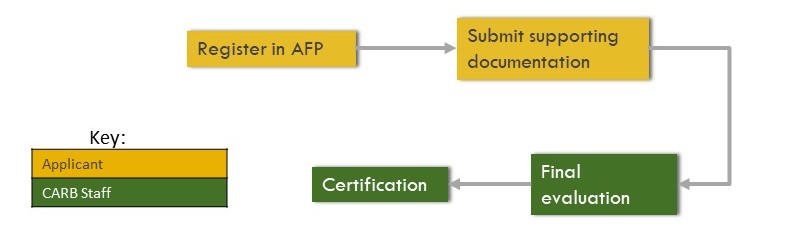
Entities seeking to report fuel transactions for CARBOB, Diesel, Compressed Natural Gas, Propane, California Average Grid Electricity, and Smart Charging/Smart Electrolysis may register and report without a fuel pathway application. Please see LCFS Regulation Table 7-1.
Tier 1 Pathways
LCFS Regulation sections 95488.6
A Tier 1 application is used to establish a fuel pathway’s carbon intensity (CI) using CARB-approved standardized methodologies, inputs, and assumptions rather than a project-specific life-cycle model. The applicant provides the required production, feedstock, and operational information and uses the applicable Simplified CI Calculator to calculate the pathway’s CI. Tier 1 applications are subject to the applicable LCFS eligibility, documentation, and verification requirements before CARB certifies the pathway.
Tier 1 pathway applications require the submission of a discrete set of inputs to calculate the carbon intensity. Applicants must submit documentation to substantiate Simplified CI Calculator inputs to CARB during that period. Tier 1 applications require at least 3 months of fuel production data and corresponding feedstock procurement records.
In addition to submitting an application to CARB, the applicant must provide the required documentation to a CARB-accredited verifier as part of mandatory validation or verification. For more information, visit LCFS Verification.
Tier 1 pathways follow the application steps shown below:

Tier 2 Pathways
LCFS Regulation sections 95488.7
A Tier 2 application is used when a fuel pathway requires a project-specific carbon intensity (CI) determination that cannot be appropriately calculated using the standardized assumptions and methodology available under the Tier 1 pathway process. The applicant provides facility-specific operational, production, feedstock, and other technical information needed to support a more detailed life-cycle analysis. CARB evaluates the submitted information and modeling to determine an appropriate CI value in accordance with the applicable LCFS regulatory requirements. Tier 2 applications are based on CARB-approved modifications to Tier 1 calculators or the CA-GREET4.0 model.
For guidance on submitting Tier 2 electricity pathways, refer to Electricity and Hydrogen Provisions and Application Checklist for Tier 2 Electricity.
In addition to submitting an application to CARB, the applicant must provide the required documentation to a CARB-accredited verifier as part of mandatory validation or verification. For more information, visit LCFS Verification.
Tier 2 pathways follow the application steps shown below:
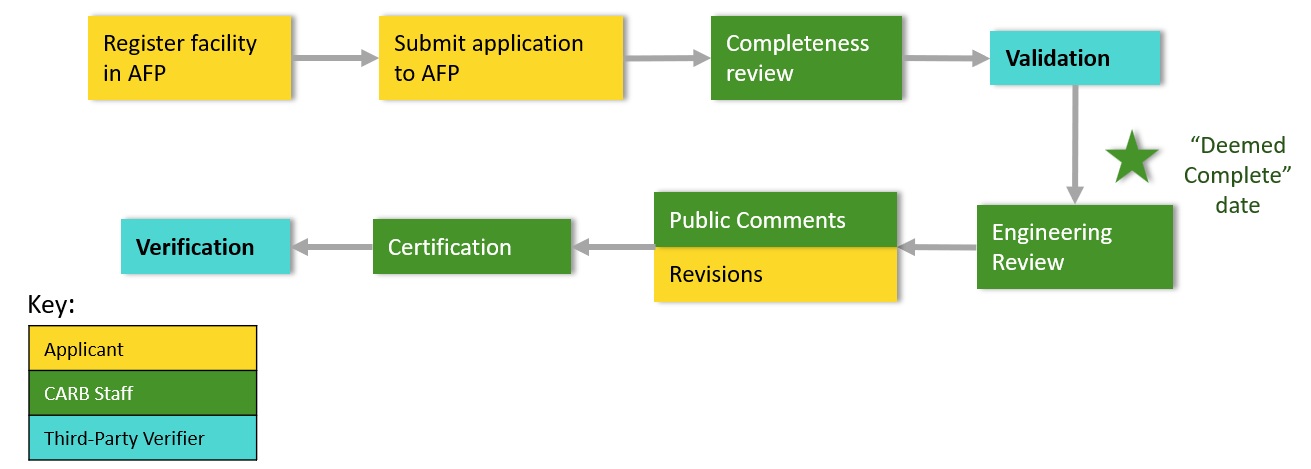
Temporary Pathways
LCFS Regulation sections 95488.9(b)
A Temporary pathway application is used to establish a temporary fuel pathway when a facility does not yet meet the data requirements for a permanent pathway, such as having less than the required period of fuel-production data, or when a new feedstock or fuel type is not adequately represented by an existing certified pathway. A Temporary pathway allows the fuel to receive a temporary CI for a limited period while the applicant develops the production and other data needed to support a permanent pathway application.
Entities may apply to use a Temporary fuel pathway carbon intensity value in Table 8 of the LCFS Regulation for facilities with less than three consecutive months of operational data, or a facility that has a new feedstock that cannot be reported under a Tier 1 or Tier 2 pathway. A Temporary fuel pathway may be approved for up to two consecutive quarters per application.
Please see the Temporary Pathway Questionnaire for pathway application requirements and additional details. This questionnaire must be submitted as part of the application.
To request that CARB consider the approval of any new Temporary Pathway not in Table 8, please contact CARB LCFS Pathway Processing.